The Jolana Star VII Electric Guitar
Last updated 7/26/24
By Paul Marossy
Here is a "very rare" electric guitar which was manufactured in Czechoslavakia, behind the "Iron Curtain", by a company named "Jolana". It turns out that behind this guitar
is another very interesting story which is virtually unknown in the USA. I first stumbled upon this guitar while perusing listings on ebay. I was immediately struck by
the styling of it, and when I did a little research on it I discovered that it had some really interesting and unique features when compared to anything made in
the western world. Therefore, I just had to have it!
While I was waiting for it to arrive, I did some further research on Jolana and found a wealth of information at jolana.info; although there is a lot of info to be found there and at a certain
Russian guitars forum, not much info
is to be found on the Star VII specfically, which is one reason why I decided to create this webpage. If you want to learn more about Jolana specifically, you can visit
the site I have linked. The very condensed story of "the Czech Leo Fender" is that a man named Josef Ruzicka created the company called Jolana, named after his daughter, in the early 1960s. They produced quite a few different guitars between 1962 and 1991 - over hundred different models in all. While total production numbers seem to be lost to history, from what is known,
over 156,000 guitars were made during the years the company was in operation. Keep in mind, this is for only fourteen of their models. There is undoubtedly tens of thousands more to add but this information was either lost or destoyed when the Soviet Union collapsed. As far as the Star VII is concerned, it IS rare when compared to the overall production
numbers. Something like only 3,500 Star VIIs were made between 1965 and 1974, which equates to probably less than 1% of the guitars made by Jolana was the Star VII. So that's kinda
cool but even so it's still considered to be a "cheap" guitar of little value. I however feel that this guitar in particular is highly underrated. When it's set up well it's
quite playable, it stays in tune much better than either of my MIM Strats, has a distinctive sound and you'll be pretty much be the only one around with this guitar. It seems to be
inspired by the Stratocaster but thankfully it's not a blatant copy. In the case of Jolana guitars there seems to have been some western influence as Czechoslovakia wasn't in quite the same kind
of cultural vacuum as the Soviet Union, which is reflected in some of the bizarre guitar and guitar effect designs that came out of the USSR.
My particular Star VII was made in 1974 and is in remarkably good condition for its age. The thin body (30mm) is made of alder, and the neck profile reminds me of an early 60s Gibson
Melody Maker. The neck is maple with a beechwood fret board. It has small frets, only 2mm. One interesting thing is that it utilizes a ZERO FRET. I've never had a guitar
with a zero fret, so that was one reason why I wanted to get this guitar. Another interesting aspect is that it is a short scale guitar. My guitar wants to intonate at a
scale length of 23.5", which is 1.25" shorter than a Gibson and a full 2" less than a Fender. It is very comfortable and easy to play. The third thing that fascinated me was
the unique patented pickups. The patent was granted in 1962 by the Czech Socialist Republic (see link at bottom of this page). More details on this pickup below. The fourth thing
about this guitar is the bridge system which allows for upwards and downwads movement. It's very simple and stays in tune remarkably well (as one who does not do any sort of violent whammy bar stuff). This bridge system first appeared on the Grazioso model in 1962. The last thing that I like about this guitar is that at 6.3 lbs, it is considerably lighter than the comparatively back breaking Stratocaster. Size-wise, these are approximately the same size as a Stratocaster but the body may be just different enough to not fit in some hard shell guitar cases.
Below is some more detailed information about this interesting guitar. (Note: Most of the pictures below are not of my own guitar)
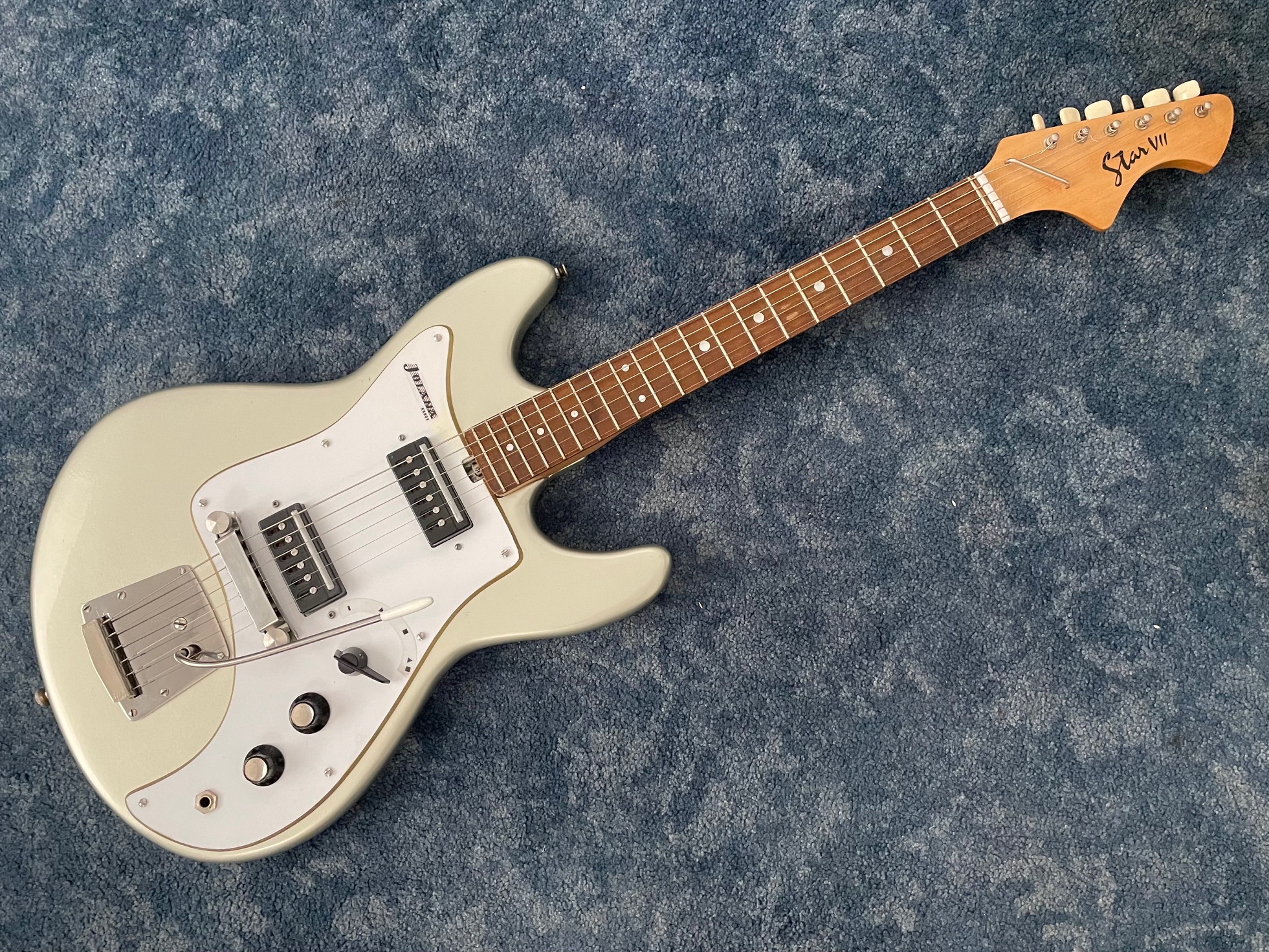 |
This picture is of my own guitar. I like the way it looks. One of the few Soviet-era guitars that isn't a total weirdo! It's similar to the color in the picture directly below but it looks gold-ish when the light hits it a certain way, and more silver in less bright light. I'm not 100% sure if it's the original paint or not. I have seen similar examples so I'm leaning towards it's the original paint. |
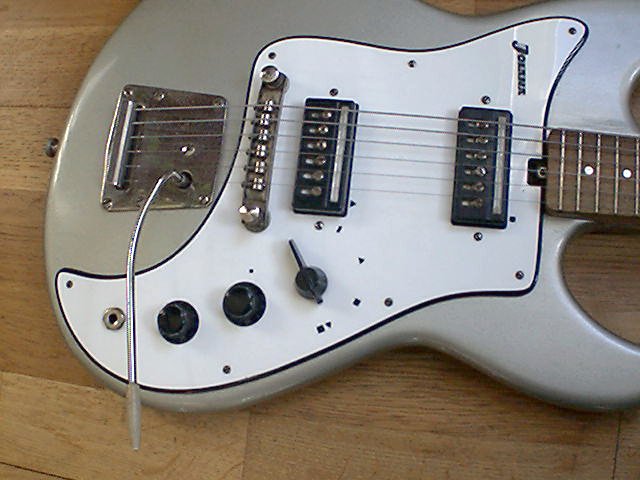 |
The pick guard is an interesting shape with the borders painted either black or gold. The bridge is not fixed, it floats on top of the pick guard. The controls are very simple - a single volume control and tone control. The pickup selector switch is rather unique - the position closest to the strings turns all pickups off, the next position down is the bridge pickup only, the next position downwards is the neck only and the furthest position down is bridge and neck combined. The pickups also have little squares or triangles next to them as well, matching the symbols at the switch, but not all examples seem to have this feature. This guitar uses a standard 1/4" output jack. |
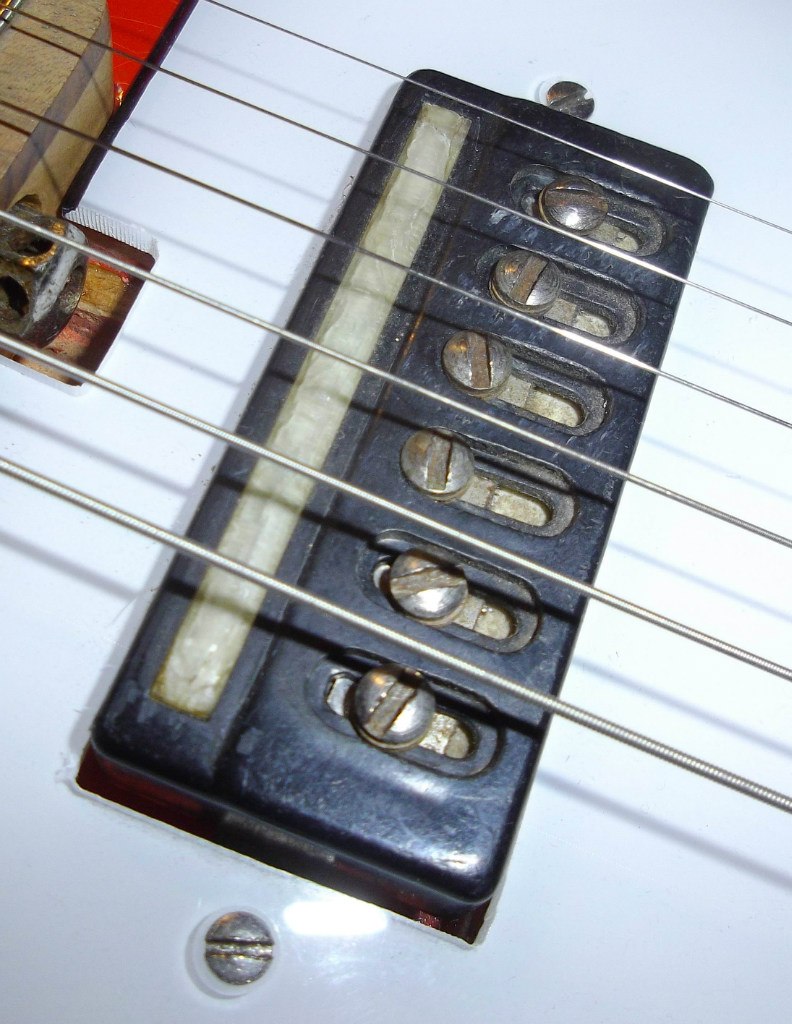 |
The "Brilant De Luxe" pickups are a very interesting design. Rather than having pole pieces that adjust vertically to make the pole pieces closer / farther from the strings, this pickup utilizes sliding plates which are held in place by a screw. Moving these pieces changes the strength of the magnetic field. They have a relatively low output, with a DC resistance of approx. 6K and around 40mV output. I think that is partly what gives these guitars their distinctive sound. |
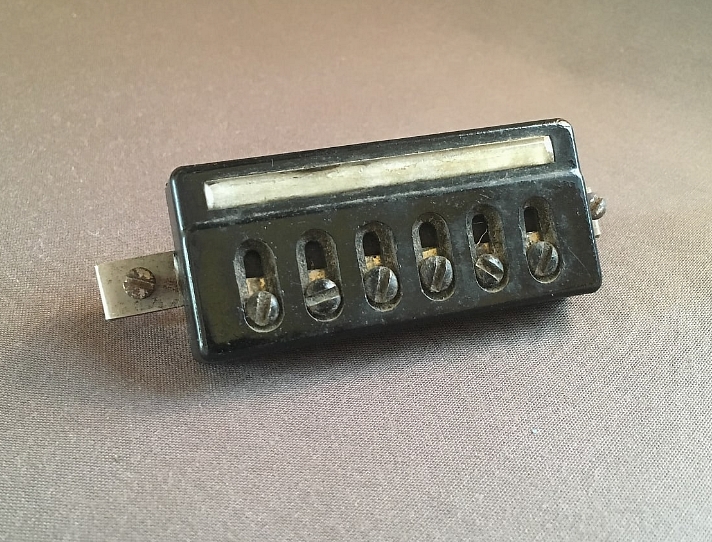 |
Here we can see the pickup removed with the two mounting tabs in view. These pickups are most commonly compared to the P90, which they do sort of sound like. |
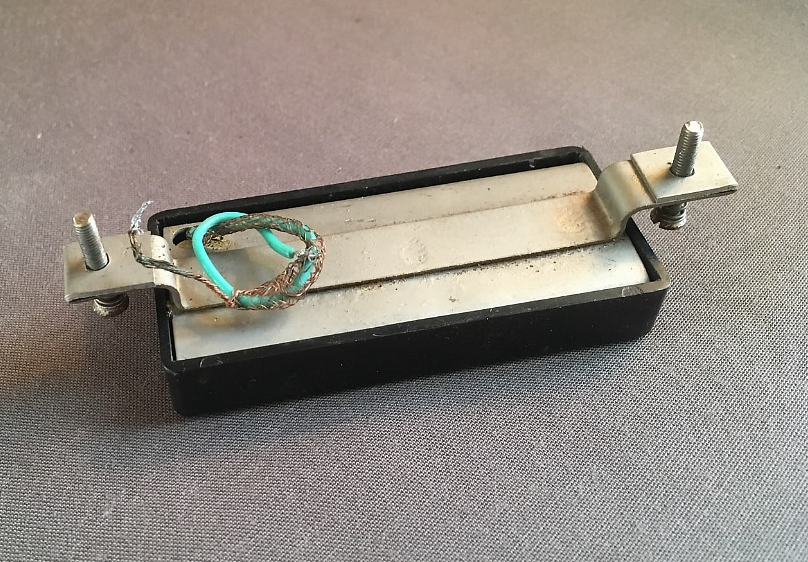 |
This is what the bottom of the pickup looks like. The baseplate wraps around two long sides of the coil & magnet and the plastic cover with screws fits over the top. It's a simple and low profile design, which allows the use of a comparatively thin body. |
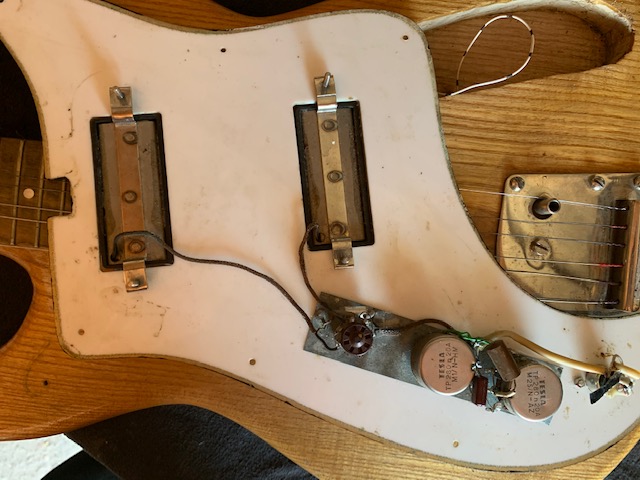 |
With the pickguard removed we can see the simple wiring. The pots are made by the same TESLA which I highlight in my Soviet-era Guitar Effects Field Guide. The pickup selector switch is an odd 2-pole 8-position rotary switch constructed of a bakelite type material which is only "half utilized". Some people have modified their pickup switch to a "Varitone" type system. Personally I like mine just the way it is. |
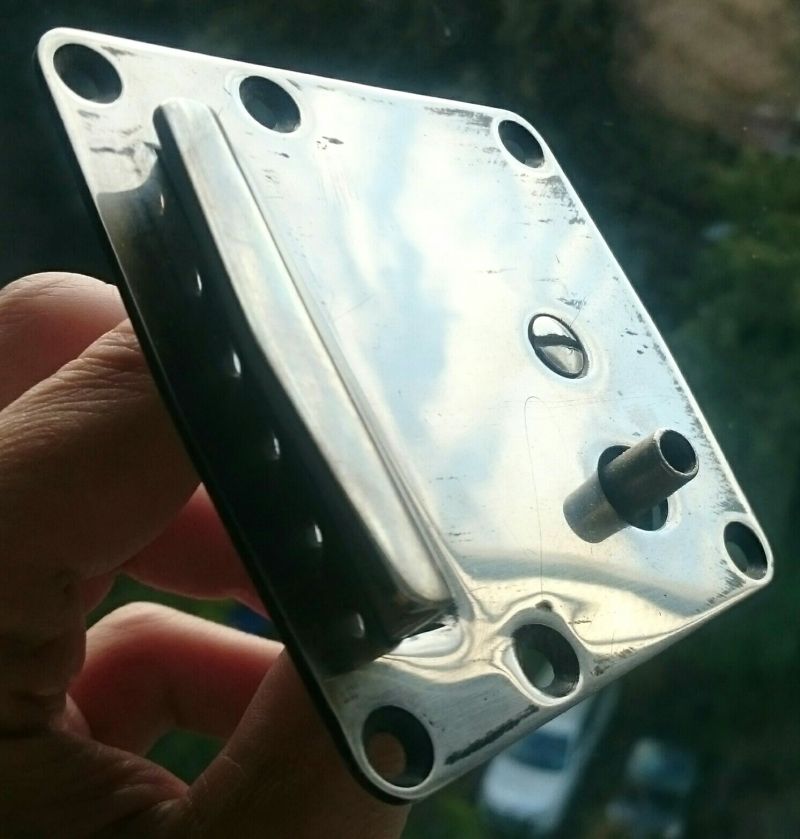 |
Here we can see the bridge removed from the body. It is a very simple and effective system that is used on a few other Jolana guitars. It consists of a plate that is fastened to the body and another spring loaded plate that is bent 90 degrees on one end which sits underneath. This passes thru a thin slot. The ball end of the strings pass through this piece which rises out of the mounting plate. There is a cylindrical piece that protudes thru the mounting plate which the threaded end of the "whammy bar" can be inserted into, and the screw adjacent to that is what adjusts the stiffness of the system. |
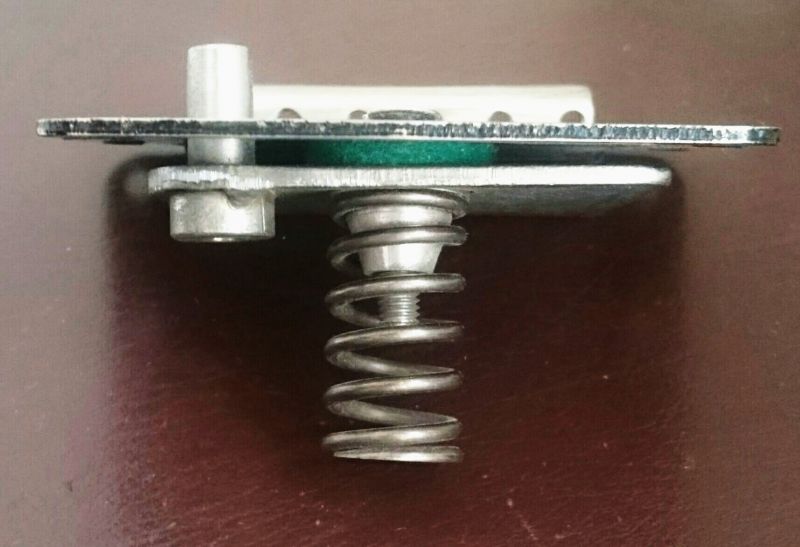 |
In this view we can see how the two pieces interact and the stout coil spring. Note that the cone on the screw which joins these two pieces together should actually be on the other end of the spring. There is a green felt pad which prevents clacking noises of the two metal plates. Basically is very similar to the "tremolo" & tail piece on the Fender Jaguar & Jazzmaster guitars. Not an exact copy but close in the overall from and function. The Fender "tremolo" system was first introduced in 1958. This version of the Jolana "tremolo" first appeared on the Grazioso model in 1961. |
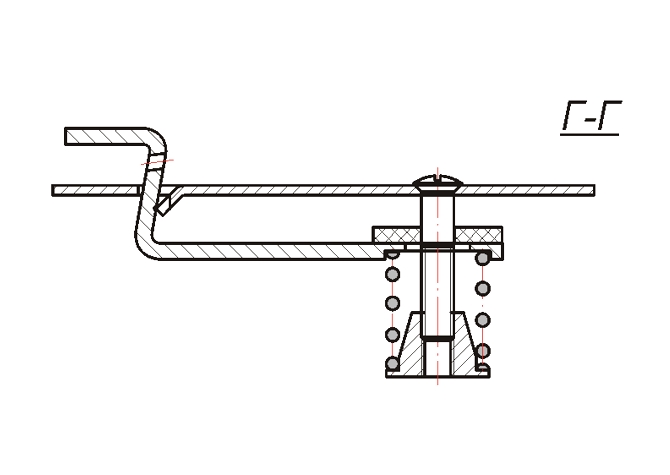 |
In this cross sectional view we can see the proper orientation of all the parts that comprise the bridge assembly. |
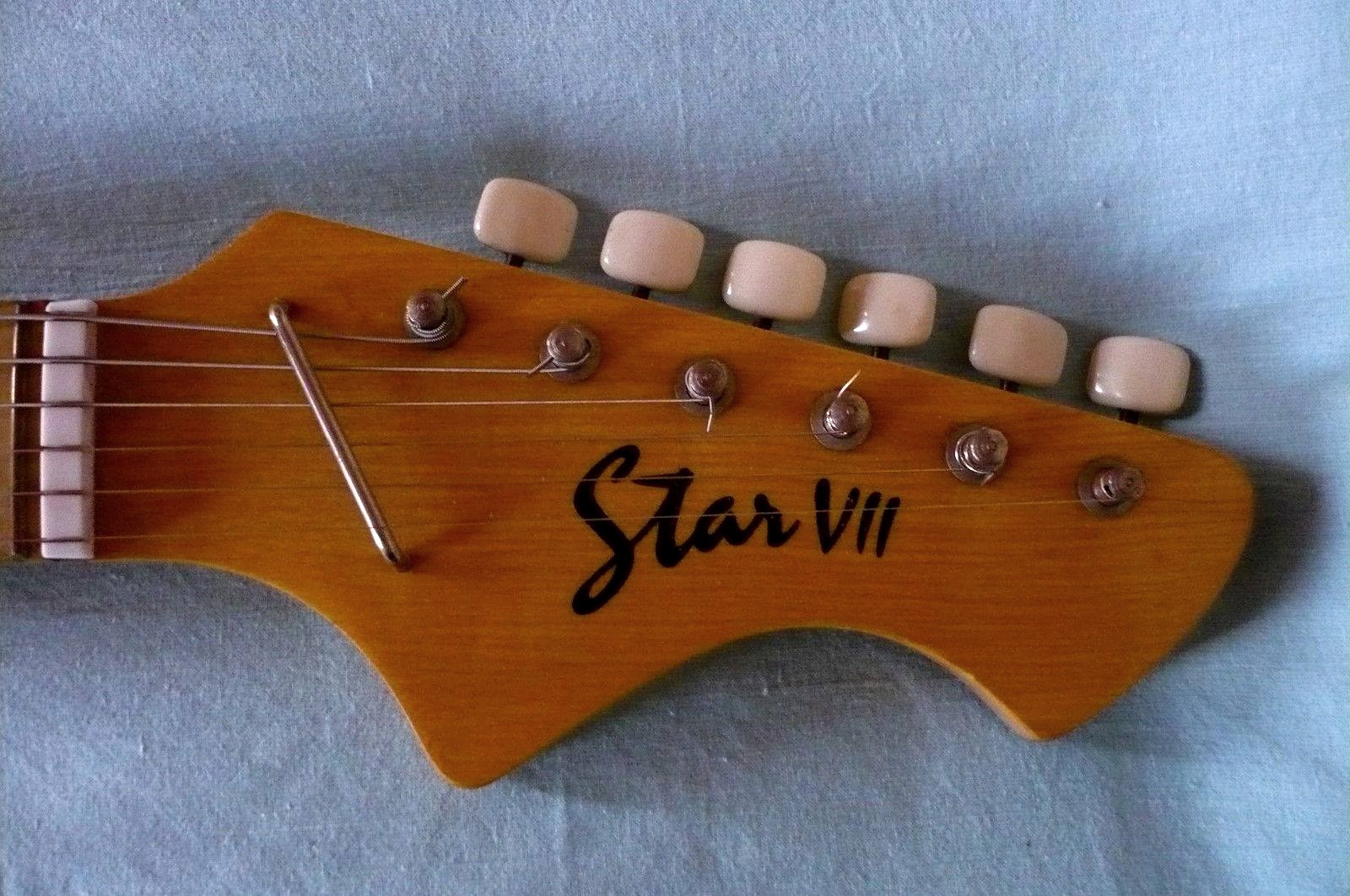 |
The headstock has a distinctive shape. Kind of quasi-Stratocaster in a way but its own thing. Definitely not as weird (or fugly) as what can be found on guitars made in the Soviet Union during the same time period. |
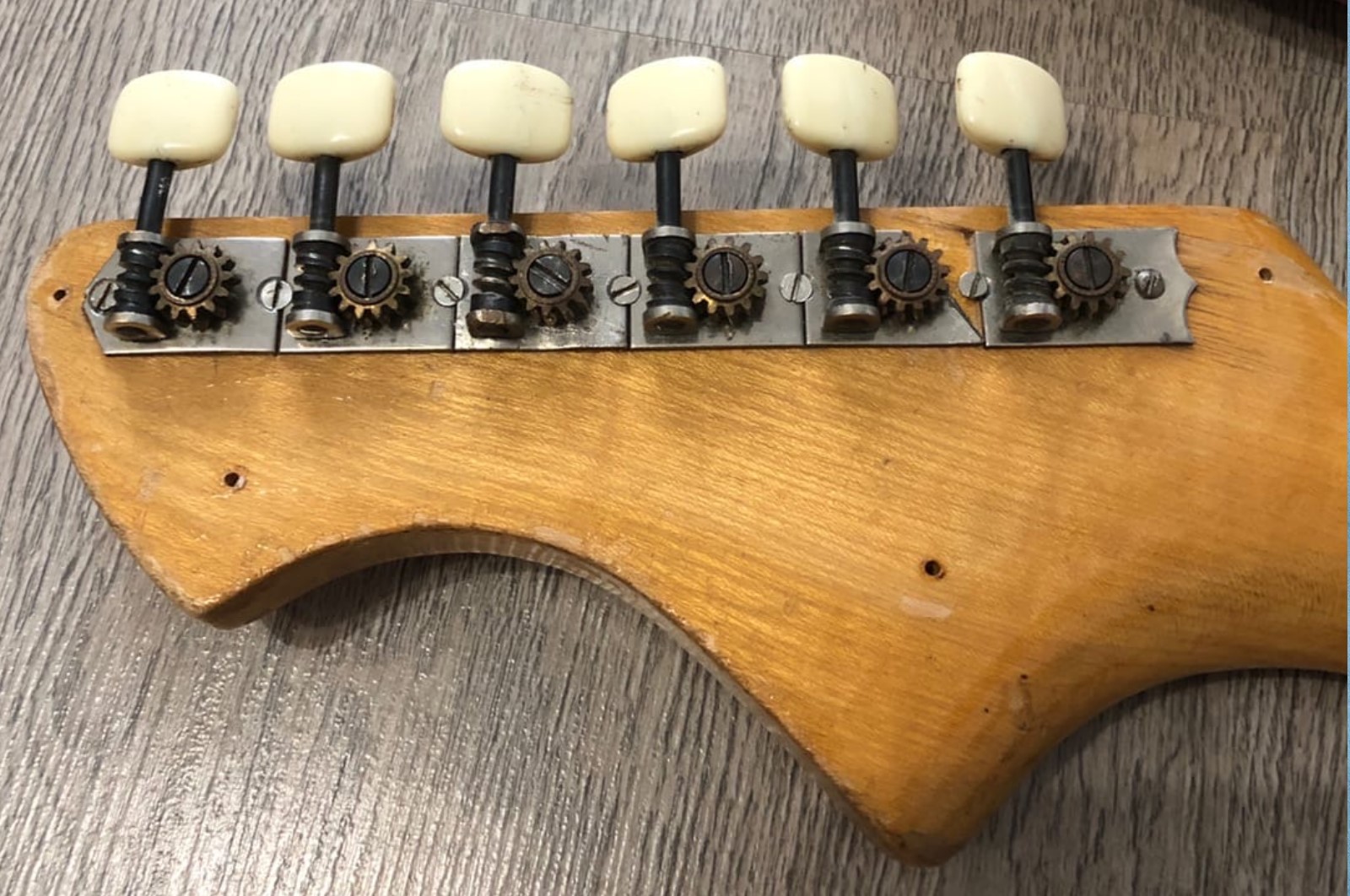 |
The back of the headstock reveals what looks like classical guitar tuners. Despite the appearance of being cheap, they are actually pretty good tuners and at least on my guitar they stay in tune pretty well. |
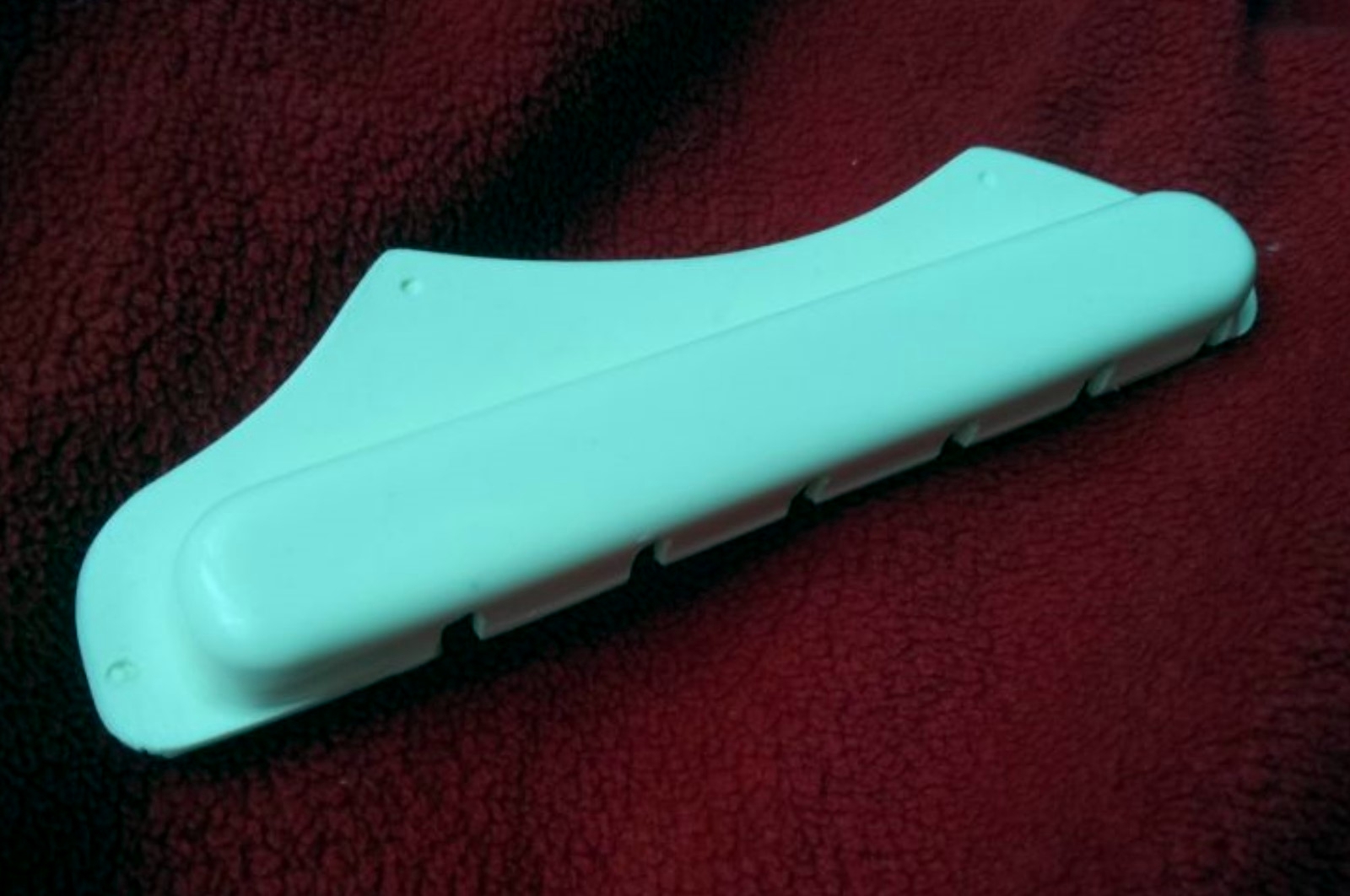 |
This piece of molded plastic fits over the tuning pegs and gears to protect them and keep dirt, etc. off of them. Once again, despite its appearance, it's more durable then you might think. I have seen these in a clear and a sort of dull clear plastic as well. |
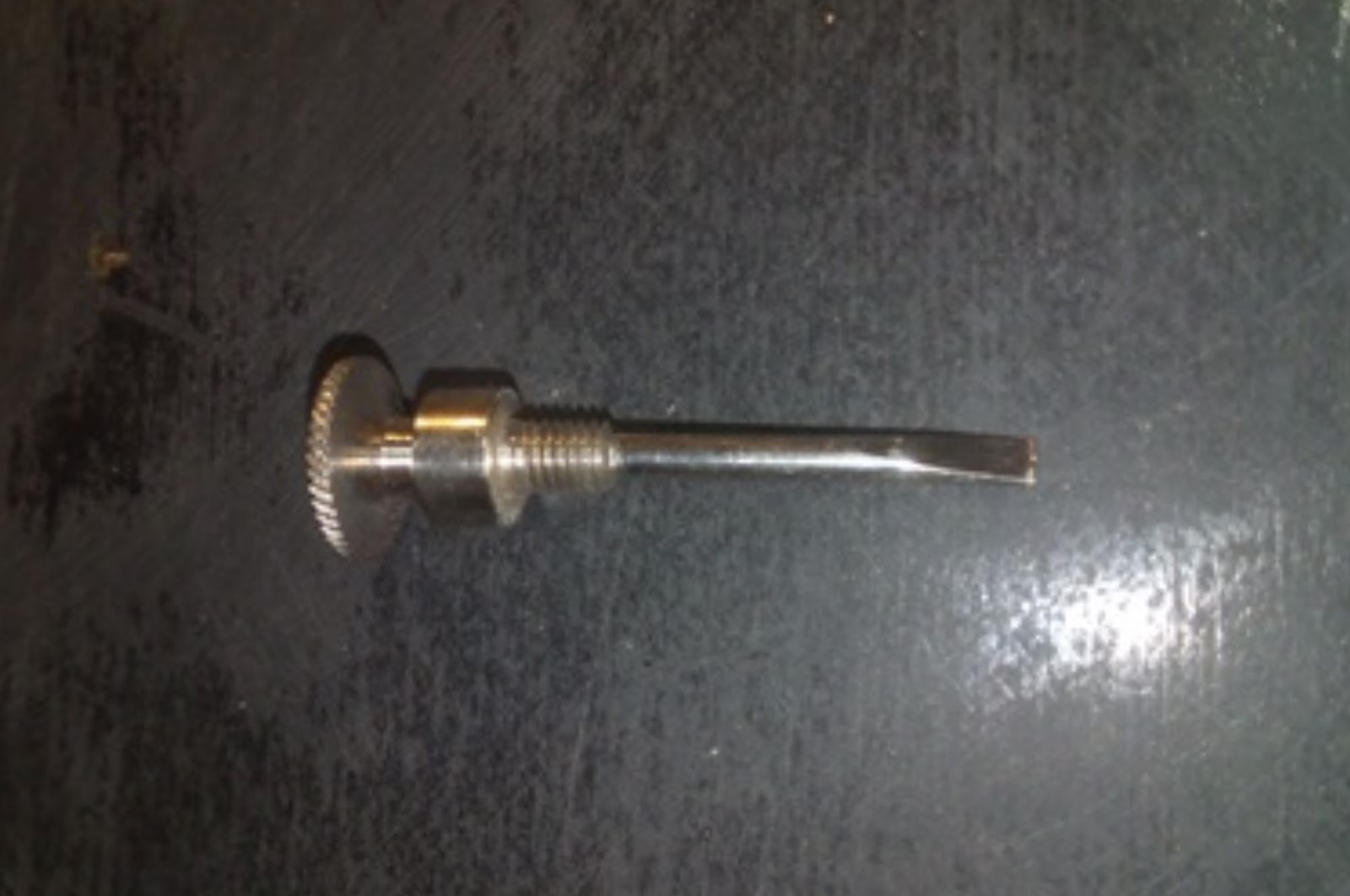 |
A unique feature of some of the Jolana guitars is the strap button screwdriver which inserts into the body near the bridge. Could come in handy to tighten up a loose screw, but it would have to be a little one because it's kinda small. It was mainly intended for adjusting intonation. |
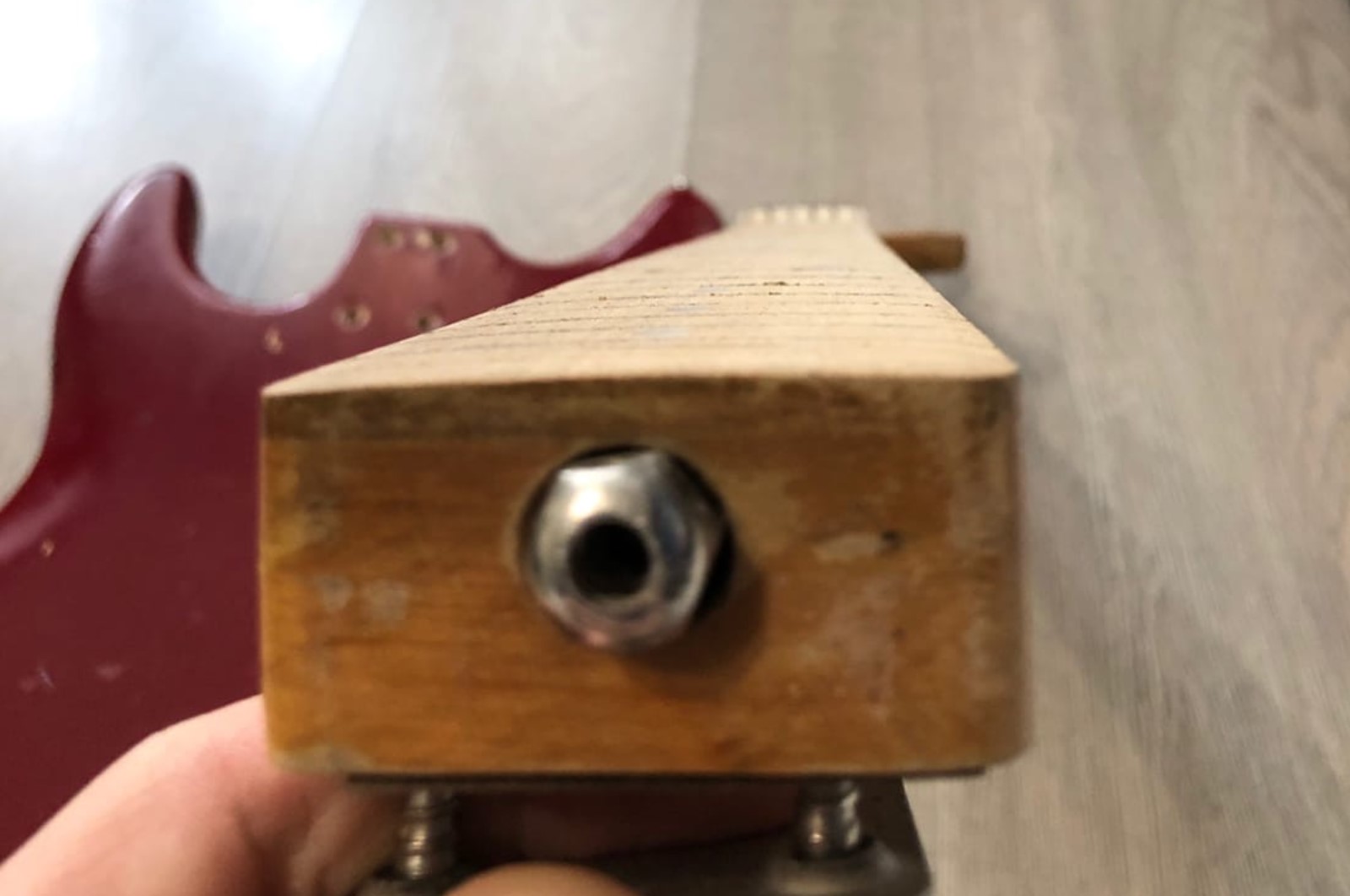 |
This picture is of someone's restoration project. Here we can see the truss rod adjustment at the heel end of the neck. There are holes drilled in the flats of the nut that a tool can be inserted into in order to make adjustments. It was kind of ahead of its time. The first time I encountered this sort of truss rod adjustment system was on my Parker Nitefly Mojo that I bought in 2005. |
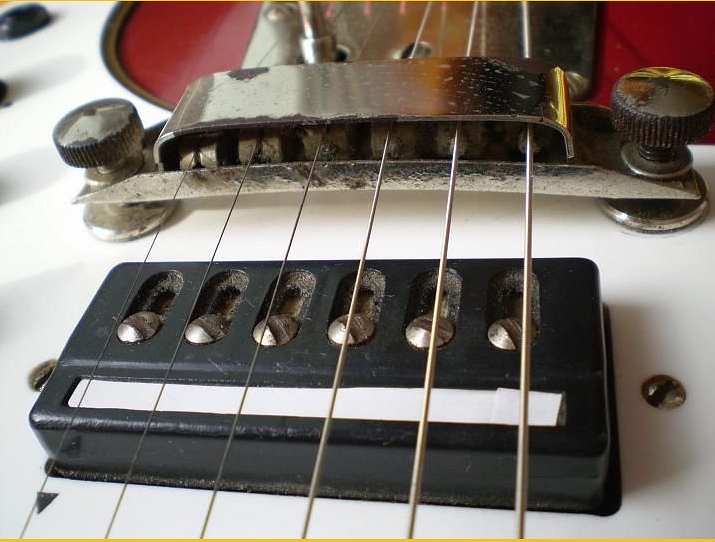 |
Finally, here is a view of the bridge with cover over the saddles. It is very similar to the bridge used on the Fender Jaguar & Jazzmaster. The bridge and saddles seem to be made of stainless steel or a high quality steel (in this picture the parts are a little rusted). The saddles themselves are also interesting in that they are like a piece of round bar stock that has been cut in sections, drilled and tapped for a long screw and a shallow slot has been cut along the round edge for the string to sit in. It's simple and it works. |
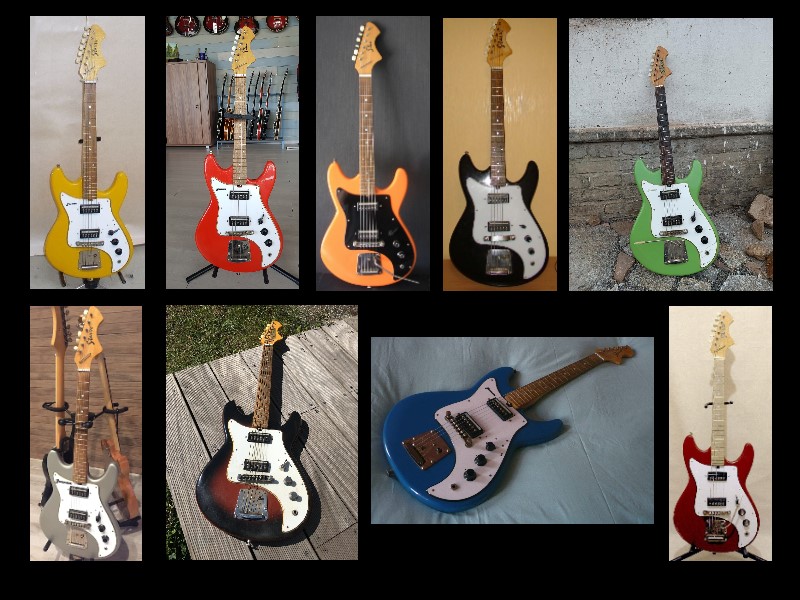
Below are some examples of the Star VII in different color schemes. I'm not sure how many of them are original factory color but I believe factory colors were at least
the two red variants, the blue one, the golden yellow one and the silver-grey one. Not sure on the rest of them. I like the sunburst one, those always look nice. In any case, these are very fun guitars and if you have the chance to buy one, I hope this page helps in some way. Just be aware that these are old guitars and some of the wiring may have been tampered with either
intentionally or because something broke and an exact replacement was not available. Or someone "upgraded" it, ruining its originality. I have also seen a variety of different styles of knobs on these guitars. I have no way of
knowing if they came from the factory like that or if someone replaced them at some point in time. I believe the original factory knobs are same as what is shown in the first picture on this page, with the chrome insert on the volume and tone knobs. The original pickup selector knob typically had the long blade, as can be seen in most of the examples on this page. The factory pickguard was always white with the Jolana logo shown below, in black above the neck pickup.

Jolana Bridge Dimensioned Drawings