The Secret Life Of Polytone Speakers
Created 5/2/26
Last updated 5/2/26
By Paul Marossy
Having rescued two Polytone Mini Brutes that started out as just a homeless preamp chassis and power amp, I was confronted with the complicated task of trying to
pair them with an appropriate speaker. Trying to determine what specs the original OEM speakers were made to turns out to be very elusive. Gone are the days when I
could just email Eminence and they would respond to me with actual information, at least what they could give me. Since I have an OEM 12" and 15" speaker I am very
tempted to perform some testing on them so I can finally answer some of these questions, but in the meantime I thought it would be interesting to put together
everything I can find about the OEM speakers, what some people claim may be a good replacement, and what I think may be a pretty close one.
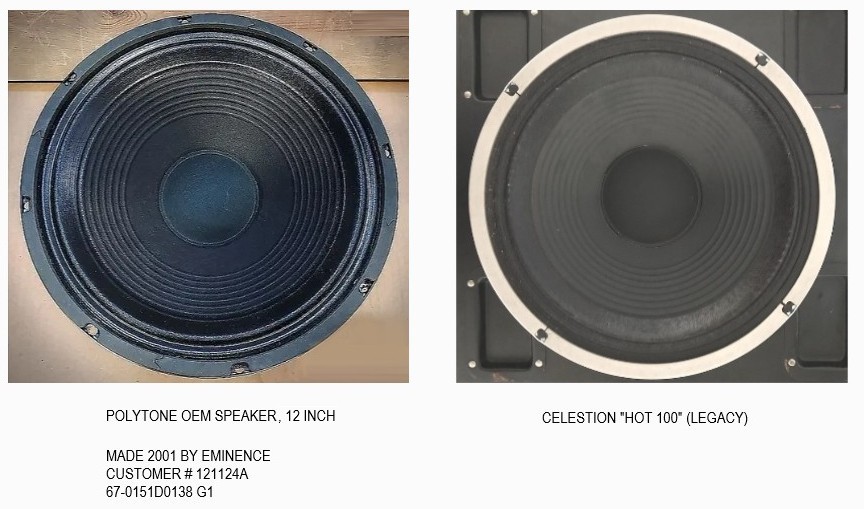
While experimenting with various speakers to get "that Polytone sound", I discovered that what actually sounds pretty close to the OEM speaker is the Celestion
"Hot 100" Legacy speaker. It's rated for 100 watts with a freq response of 80Hz-5kHz, and this seems to be about right. It sounds very similar to the OEM speaker in my
practically mint Mini Brute II. Also, the corrugations are close with respect to the spacing and there is about the same number of them
too. Yes, the corrugations are to make the cone stiffer but they can also be used to shape frequency response. I believe both have a 2" voice coil, and are
100 watts. I know there are other factors to consider but the paper cones appear to be roughly the same composition although I am not sure if the OEM speaker uses
a cloth surround or not. It seems to not be cloth, but if it were, that would likely dampen the highs a little bit. This might not even matter in the Polytone circuit.
Another unknown is the magnet weight, but they are likely similar. I believe they also both employ a copper voice coil. Likely the voice coil inductances aren't radically
different either, when comparing 4 ohm speakers.
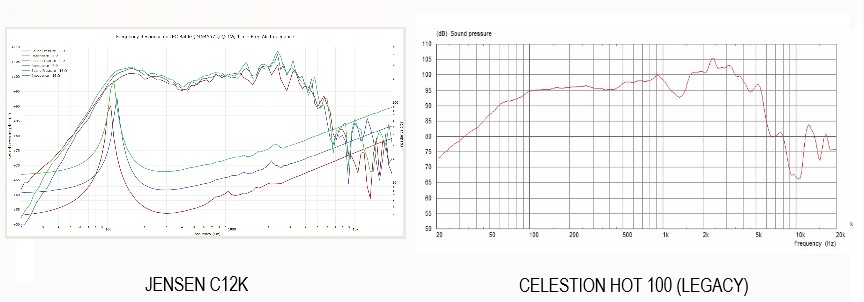
If we compare the Jensen C12K to the Celestion Hot 100, we can see that the Celestion has a much flatter frequency response. This is therefore a better choice for
use in a Polytone Mini Brute.
But we shouldn't get too stuck on specifics. Polytone has used speakers with all sorts of characterstics in their amps. Early models had CTS speakers, and
later models used Eminence. CTS became / merged with Eminence, so these speakers were always made by the same manufacturer. In any case, below are a few examples of OEM speakers
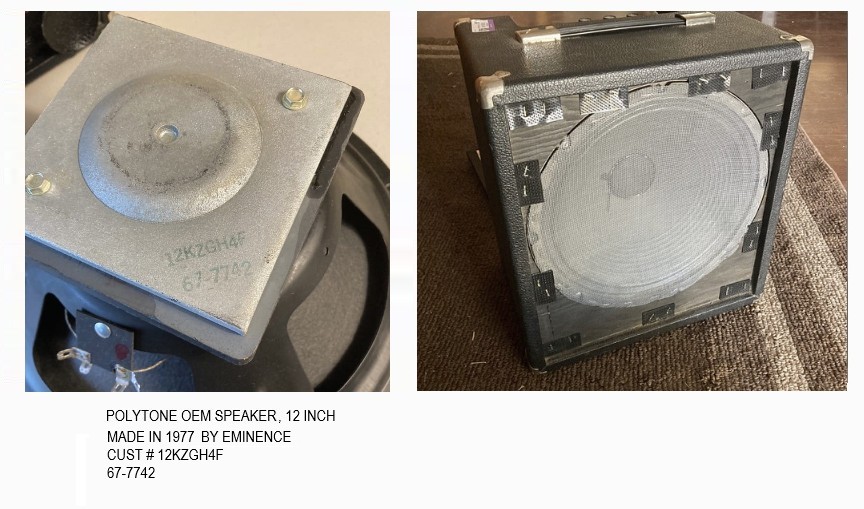
which shows the differences between them. Directly below is an OEM Eminence speaker made in 1977, the so called square magnet type. Note there are about the same number of
corrugations on the speaker cone as the one mentioned above, and are in about the same location.
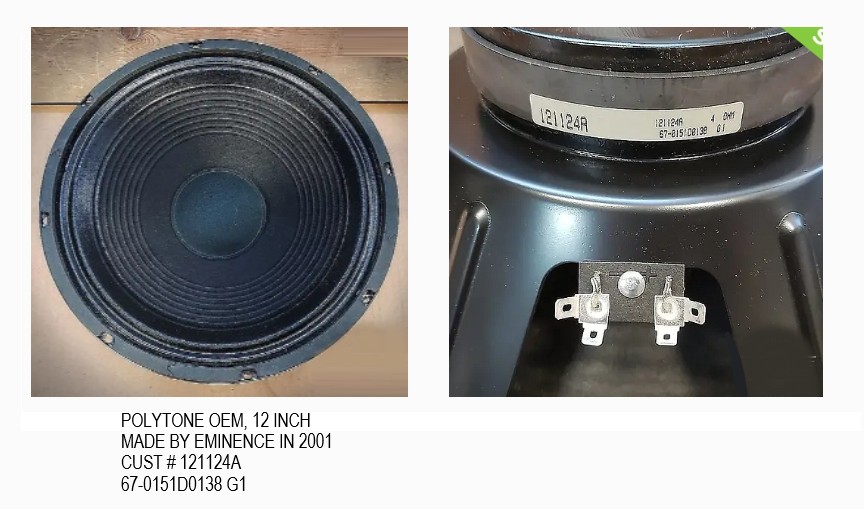
Below is a 12" OEM speaker made 24 years later than the one above. Notice the speaker cones and dust covers look pretty much the same. This seems to suggest that this speaker
design is what they settled on for use in the Mini Brute platform. The magnet here is the round type we are more used to seeing but I'd say they sound pretty much the same as
the square magnet. I do wonder why Eminence used square magnets at one time. I suspect it was primarily for economy (cheaper to manufacture). The DC resistance on this speaker
measured 3.8 ohms.
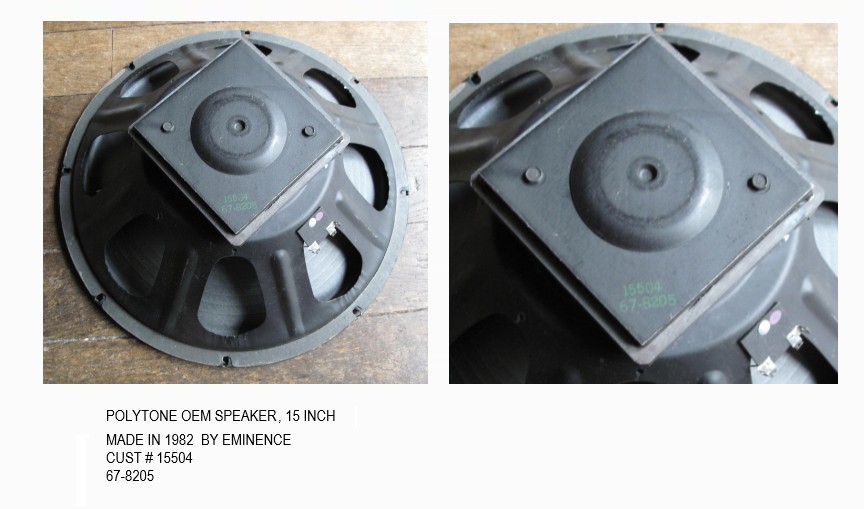
This is a 15" OEM speaker made in 1982. Don't currently have a picture of the cone, but included here for the markings on the speaker. I believe this would be the
same design as what is in my 1990 Mini Brute III, just with a square magnet instead. It has similar style corrugations as the 12" speaker.
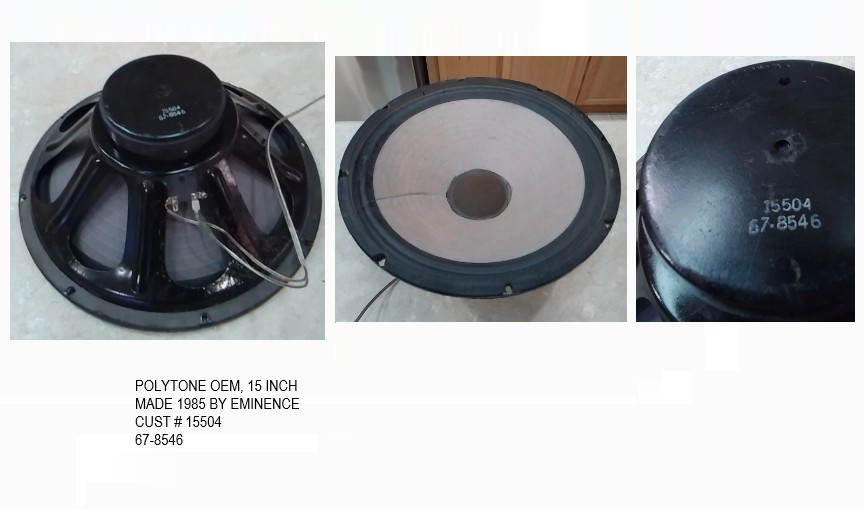
This is another example of a 15" OEM speaker, made in 1985. Note the grey colored speaker cone with very slight corrugations. I have also seen some examples of the
grey speaker cone in a 12 inch size.
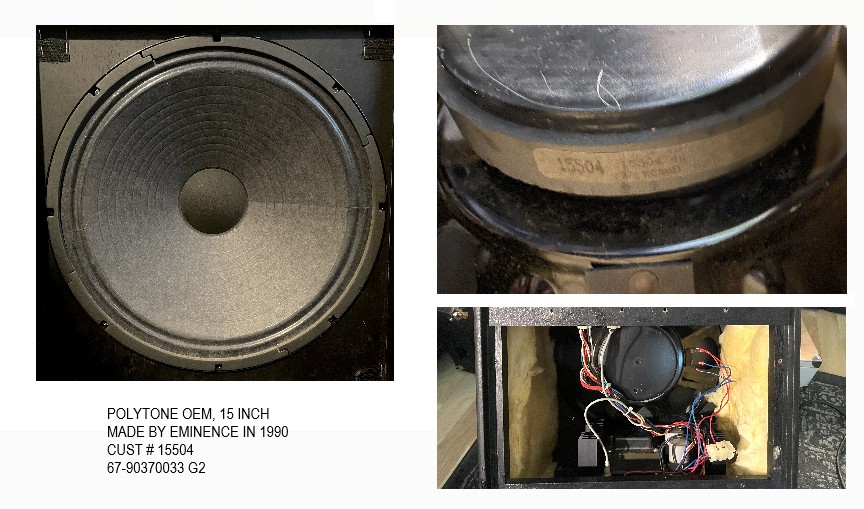
This is another example of a 15" OEM speaker, made in 1990. It is the speaker in my own Mini Brute III also made in 1990. Looks to be pretty much the same as the 1985
version above but with a different type of paper cone. The DC resistance on this speaker measured 2.8 ohms, which coincides with the stated 3 ohms on the back panel.
It has a nice sound and it does not lack any high end frequency response.
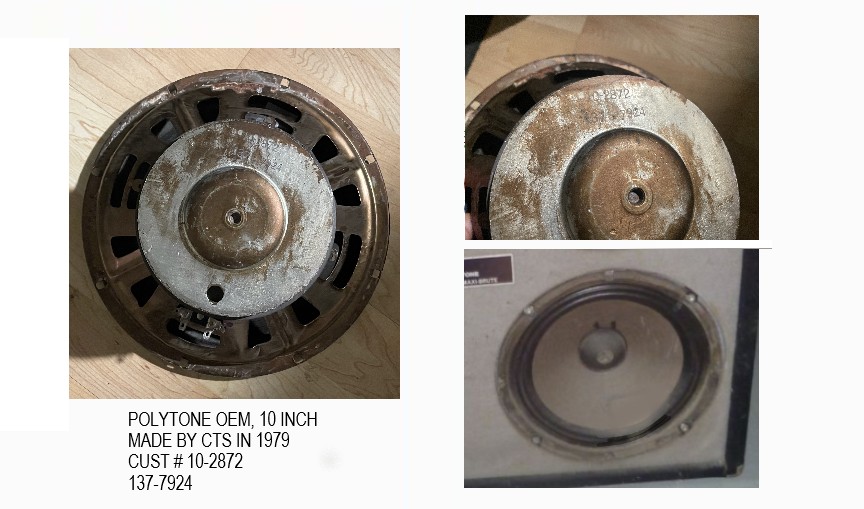
This is a CTS speaker manufactured in 1979. These were used in the Model 104 "Maxi-Brute". Not sure what the wattage rating is on them. I assume they are at least 50
watts. This one had a harsh life living in Hawaii for a length of time. These used a grey paper cone, and dust caps which have a hollow center with a felt insert.
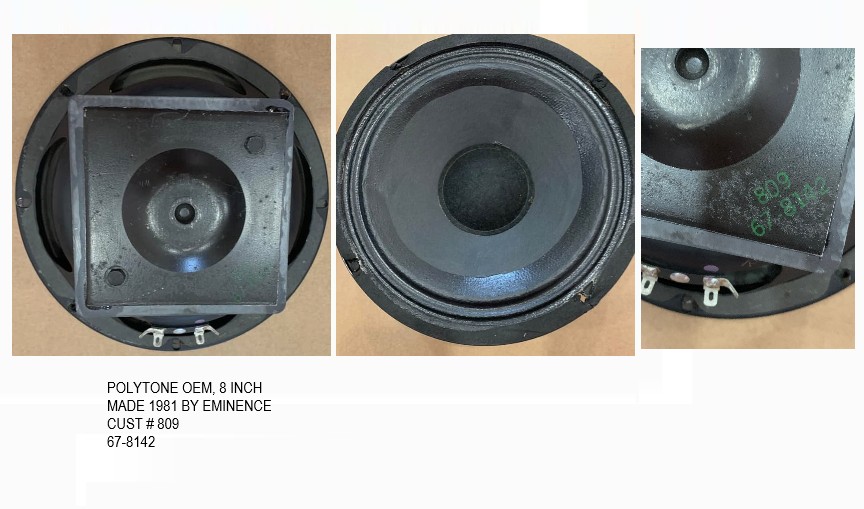
This is an 8" OEM speaker, used in the Baby Brute. Square magnet and it appears to essentially be a small woofer.
Looking at the various types of OEM speakers which were employed over the years, we can see that like with Polytone's amplifier designs, things were constantly evolving.
So if you are confronted with needing a replacement speaker for a Polytone amplifier I think the best way to approach it is to ask what time period is it from, and what
would be the closest. Perhaps one day I'll do an SPL test on my OEM speakers so the mystery can finally be cracked. I think there are quite a lot of assumptions about the
OEM speakers being modeled on this speaker or that speaker, which are more likely to be incorrect than correct. I doubt that the Polytone speaker design was a proprietary,
brand new design. Most likely was a tweaked version of something Eminence had already developed previously. It is quite possible at times Polytone took what they could
get if that meant keeping production going vs waiting on a batch of new speakers made to their exact specs to arrive, at least in the early days of the company. We have to
remember that they were competing with giants such as Fender, Peavey, etc. who may have had priority over the smaller customers.
One thing I have seen people ask, is why do most old Polytones have a replacement speaker? To quote the late90s / early 2000s Polytone Mini Brute owner's manual: "Polytone speakers are
capable of handling extreme power. They are specially designed, utilizing a high-temperature epoxy. However, when using the amplifier for long periods of time at
any overdriven, distorted level, the power into the speakers jumps to 160-170 watts- use good sense". Basically this fries the voice coil in the speaker and it dies.
It seems likely that the materials available at the time had more limitations compared to today, and these speakers were prone to failing. Likely it's simply the epoxy used in the
voice coil broke down over time, but I also believe that many players don't know how to properly approach using a Polytone amplifier. These are beautiful sounding amps if you know
how to use them. They are not meant to get the typical guitar amp sound with a huge mid scoop - but they can be good for use with guitar effects due to the flat frequency response.
And in my book, nothing works better for a jazz guitar sound but I also like these Polytones because I can sit directly in front of the amp and not hate the sound I hear coming out of
the speaker(s). It sounds just like my guitar, only louder. I love the sound of my '74 Fender Twin Reverb but at the same time it always sounds kinda harsh to my ears when
playing "clean".
One other topic that comes up a lot is the speaker impedance. Polytones were designed around 4 ohm speakers, and 4 ohm speaker cabinets in parallel. The power amps are
capable of driving a 2 ohm load. In both of my Mini Brute rescues I used an 8 ohm speaker. Yes, I'm not going to get 100 watts RMS out of the amps but believe me, they
are still plenty loud! Honestly, I don't think it matters much whether you use a 4 ohm or an 8 ohm speaker. Remember, it takes 10 times the power to double perceived
loudness. The difference between 4 ohm and 8 ohm is small when you look at it that way.
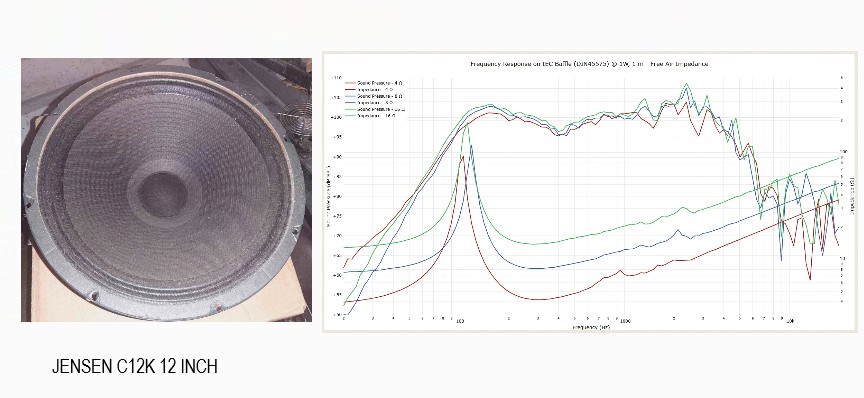
So if you do a search on this topic, you'll find quoted that the Jensen C12K "may be very close". I disagree with that. If you look at the frequency
response I think this speaker will be too shrill. There are far more corrugations on the cone than the stock Polytone speaker, which means it will have a lot more
detail in the high end, and the upper range of the speaker is something like 7kHz - much too high. I think one misconception that people initially have about Polytone amps is
that they are like many other guitar amps but just too mid-heavy, and that changing the speaker will make it more to their liking. It generally doesn't work out that
way due to the design of the amplifier. Polytones were designed to be used with virtually anything you can amplify, which requires a more flat frequency response.
This speaker is too guitar-centric to put in something like a Mini Brute and maintain "that Polytone sound".
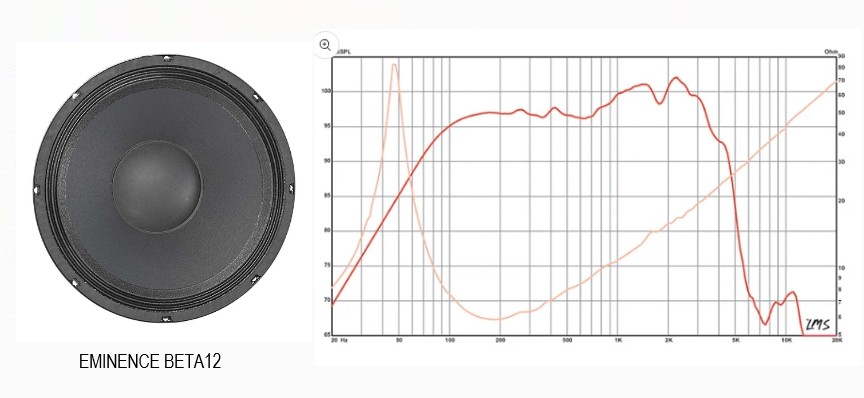
The other commonly quoted replacement speaker is the Eminence Beta-12A. I tried this in the first Mini Brute I rescued. With a frequency respsonse of 43Hz-3.8kHz
it doesn't quite do it for use with a guitar. Probably would be great for bass guitar although it will work OK in an extension cabinet in conjunction with a piezo
tweeter, as Polytone did in some of their amps like the Taurus series. Essentially this is a woofer with a cloth surround, so it's a little less efficient and the
high end is just a little lacking. It also has a very large dust cap and being rated at 250 watts, the cone is very thick, with no corrugations at all. This results in a relatively flat frequency response, but not a lot of high end.
We'll never know the truth of the matter because the owner of Polytone has died and took these
secrets with him. Eminence may not even have these records on hand either. They made some of these speakers 40-50 years ago. Not to mention Eminence has been
developing various new speakers over the years, too. So it's kind of no surprise that over the span of 40+ years of production various kinds of different speakers were used in Polytone
amps. In the end, it all comes down to personal preference but if you're looking to get an accurate Polytone sound these details matter. There may be several speakers out there that could
be suitable in the Mini Brute, but keep in mind that physical space is very limited. Speakers must be within certain maximum dimensions to fit in the cabinet.