Analyzing Wah Wah Pot Tapers via DIY Pot Taper Analyzer
Created 11/14/25
Last updated 12/04/25
By Paul Marossy
I recently purchased a Farfisa "Wha Wha / Volume" pedal. It needed a bit of repair, which was not difficult in itself although the pedal is far from being easy to work on. In any case, the pots in it were in need of replacement. The pots happened to be a dual ICAR pot. The pot for the wha wha section was marked as "0.1M / C" and the one for the volume section was marked "0.1M / Y". Before I bought the pedal I debated whether or not I could find a replacement pot because from the item description I was 95% sure the pots were scratchy. I just didn't know anything about their value and type. Now I happened to luck out as I had purchased a couple of NOS unknown brand Italian brand dual 100K audio taper pots for a project I did around 20 years ago. I replaced the old pots with this one and the wha wha section now works great but the volume function not quite so great - it gets most of the way there but can't quite achieve full volume, nor quite get to zero output. I surmised that these ICAR pots have two different tapers due to the markings of "C" and "Y". These pots are shown below.
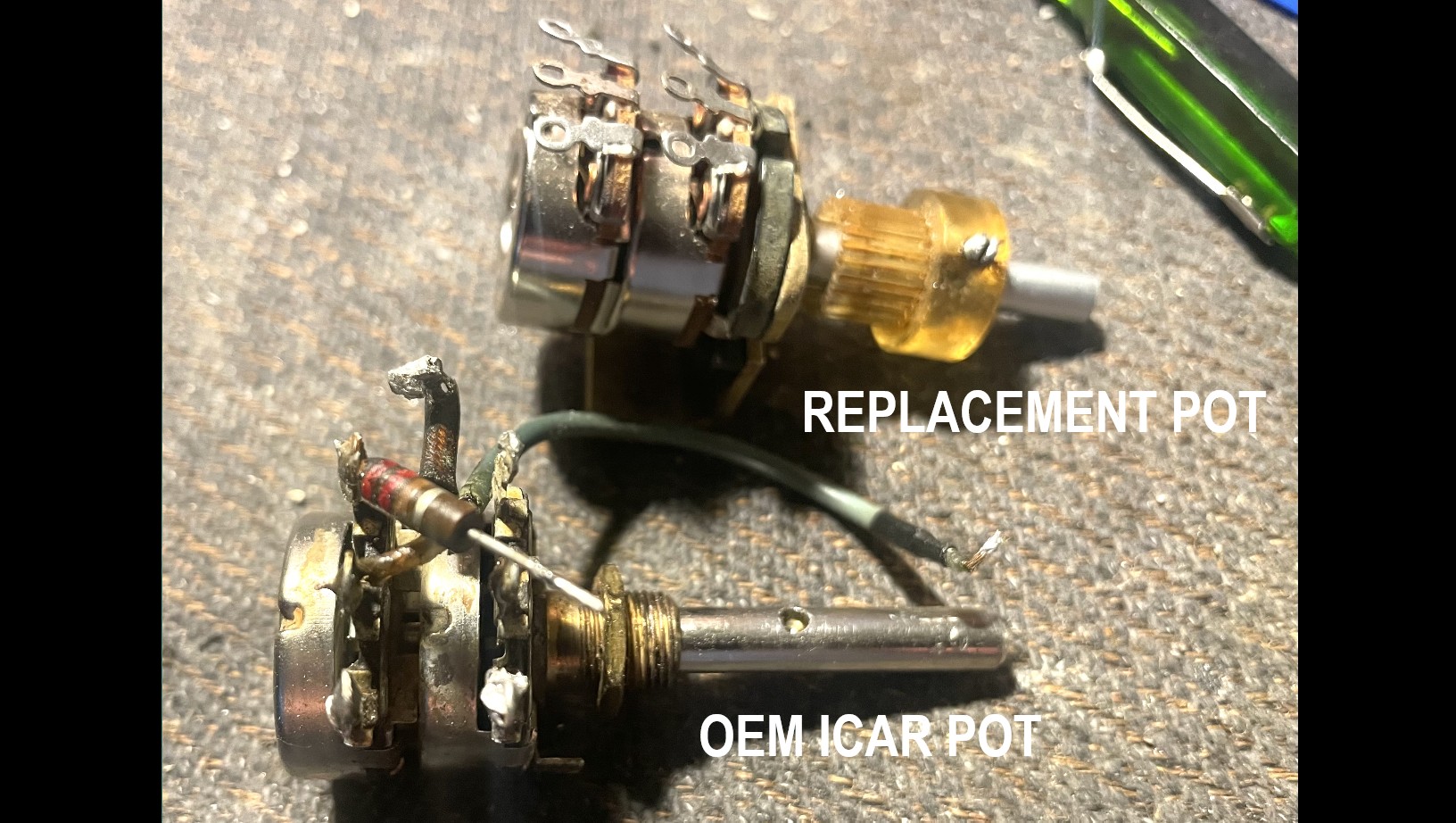
So, since I had in my possession these ICAR pots which mythological status has been assigned to, I thought "why not measure them and figure out what the taper looks like?" That is when I decided I need to make a fixture that allows me to easily measure the pot values in order to plot the measurements on a graph, so I could easily see what the curves look like. While I was at it, I also measured the unknown brand pot I used as a replacement. When I was done with this process it became clear why my replacement pot wasn't ideal for the volume function. Then it occurred to me that I had a bunch of other old "vintage" pots that I could measure and compare. The results were very interesting! And unexpected. It also shed some light on misconceptions that are out there about "vintage" wah pots vs. some of the new ones, such as the Dunlop Hot Potz II for example.
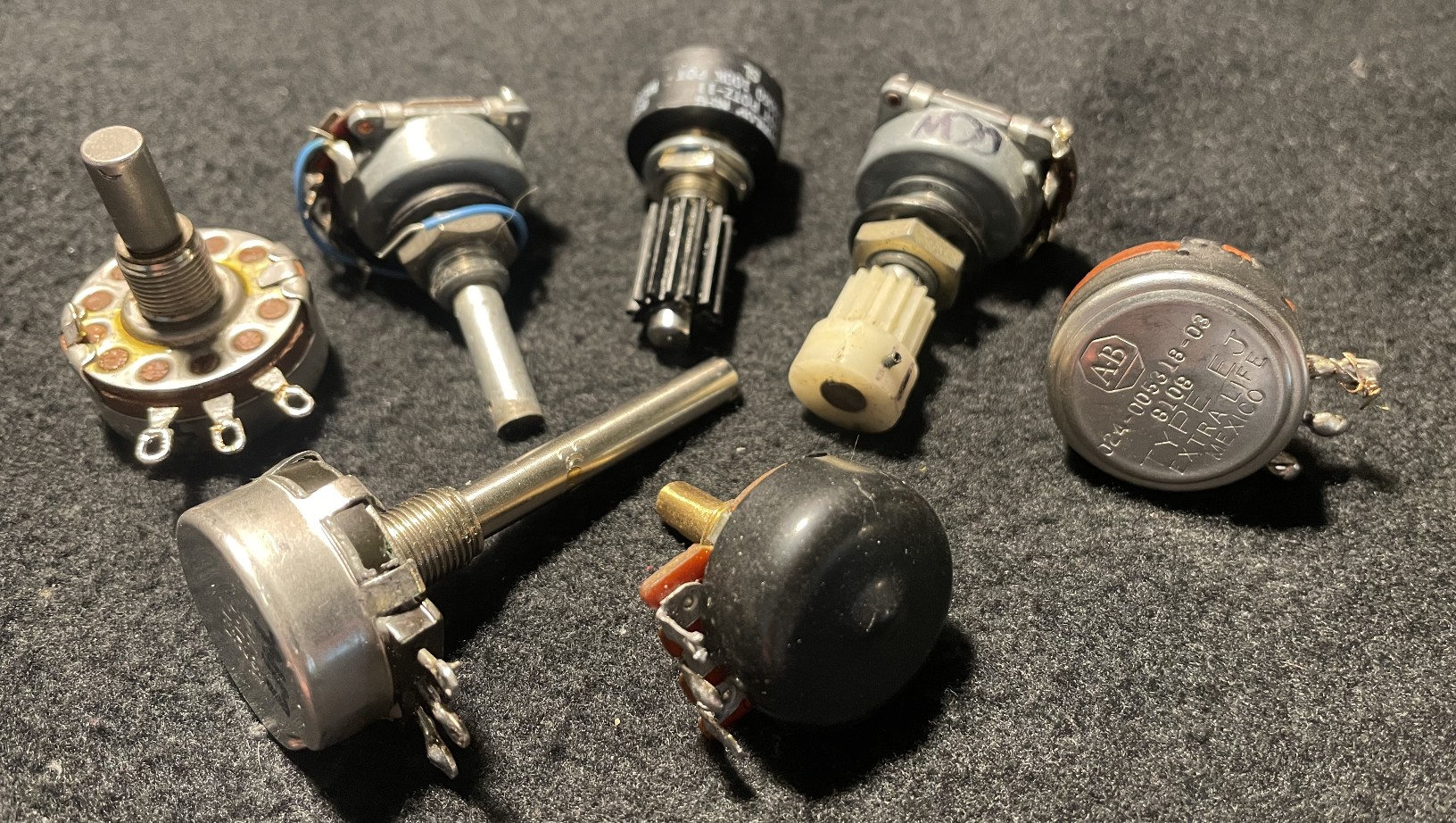
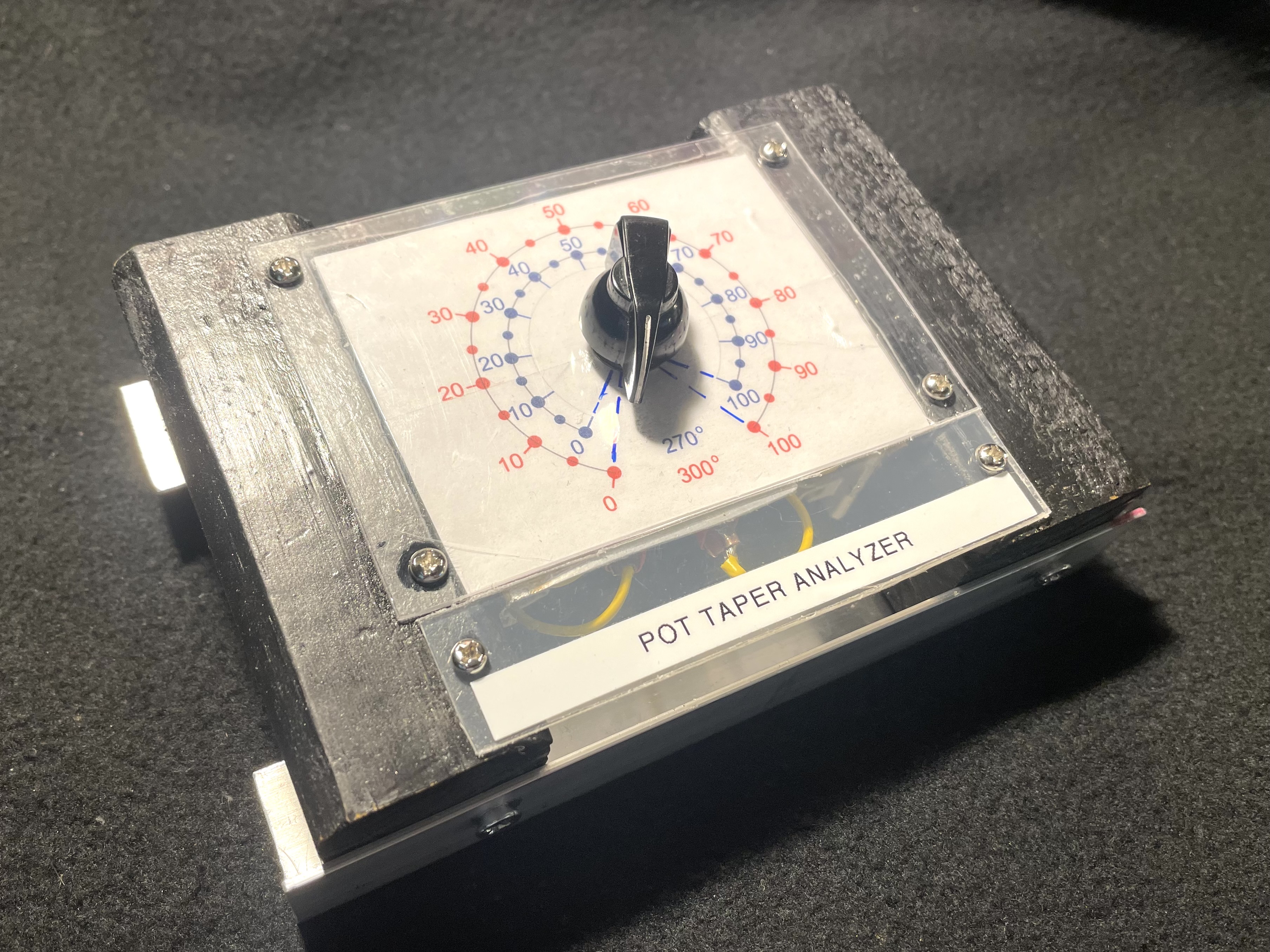
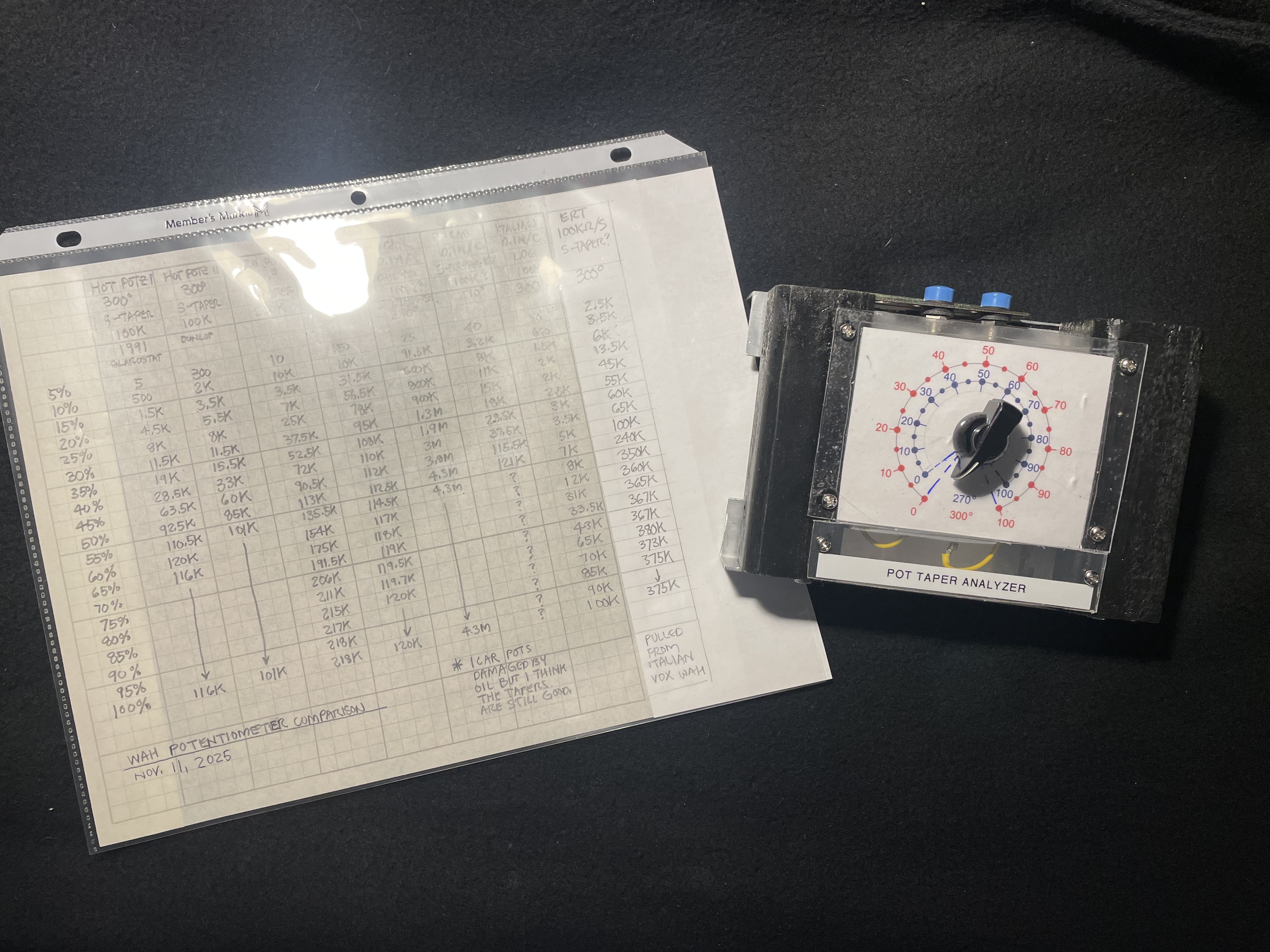
Below is the test fixture. I re-purposed the coil winding jig I made for the eBow reverse engineering videos I did a few years ago. That provided the frame. Then I devised a way of attaching the pot and some graphics that would allow me to measure pots with 270 degree and 300 degree rotations, in 5% intervals. I used some alligator clips connected to a pair of meter jacks to allow easy connection to the pot under test and a multi-meter. I used AutoCAD to make the graphics, so everything is very precise. So then the process of measuring eleven different pots commenced. All I needed to do was to measure the resistance at each 5% interval and input the results into my spreadsheet to create the curves.
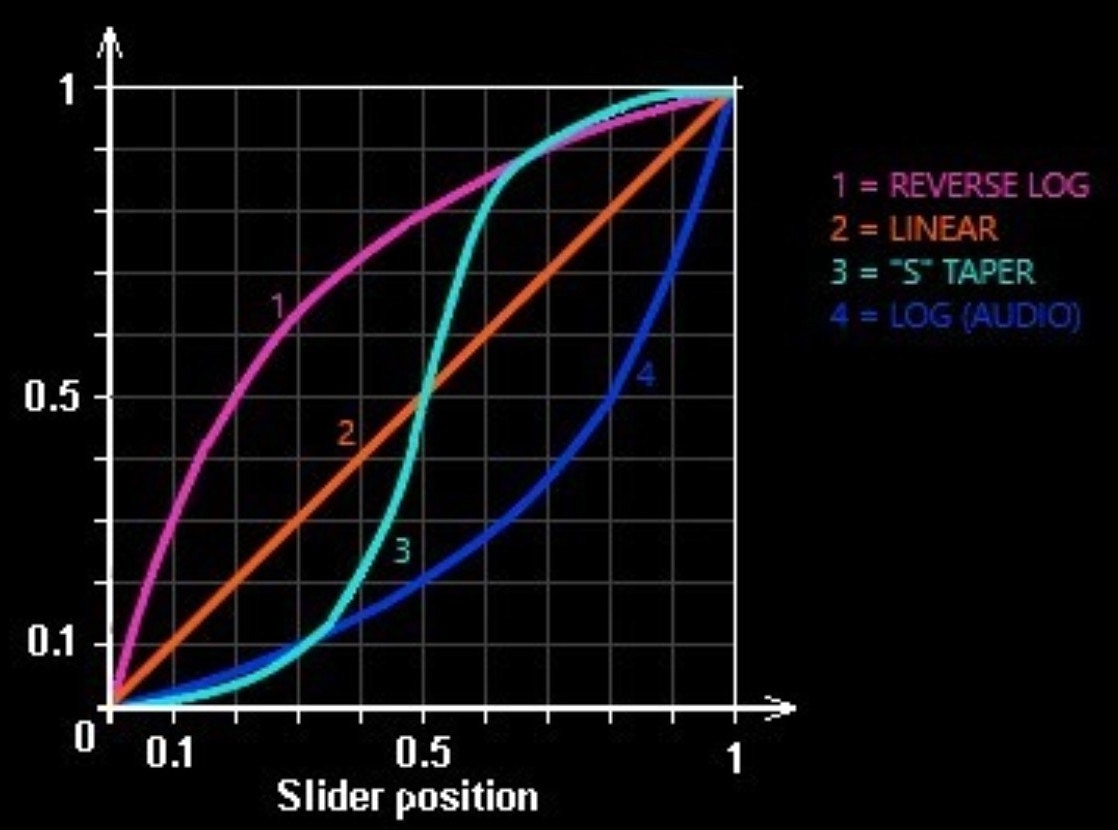
A quick word about the different types of tapers commonly encountered in potentiometers: In the graphic below we can see there are four different resistance curves, commonly
referred to as a taper.
The magenta curve is a reverse log taper. The red "curve" is a linear taper. The blue curve is an audio taper, AKA "log" taper. The cyan curve is an S-taper. Note that it
is a combination of different tapers. Notice that at the beginning of the curve it is log, in the middle it's a steep linear-ish slope and at the end it's a reverse log.
We all know how an audio pot and a linear pot works. We encounter them all the time. Linear pots do not make a good volume control. A reverse log pot as a volume control
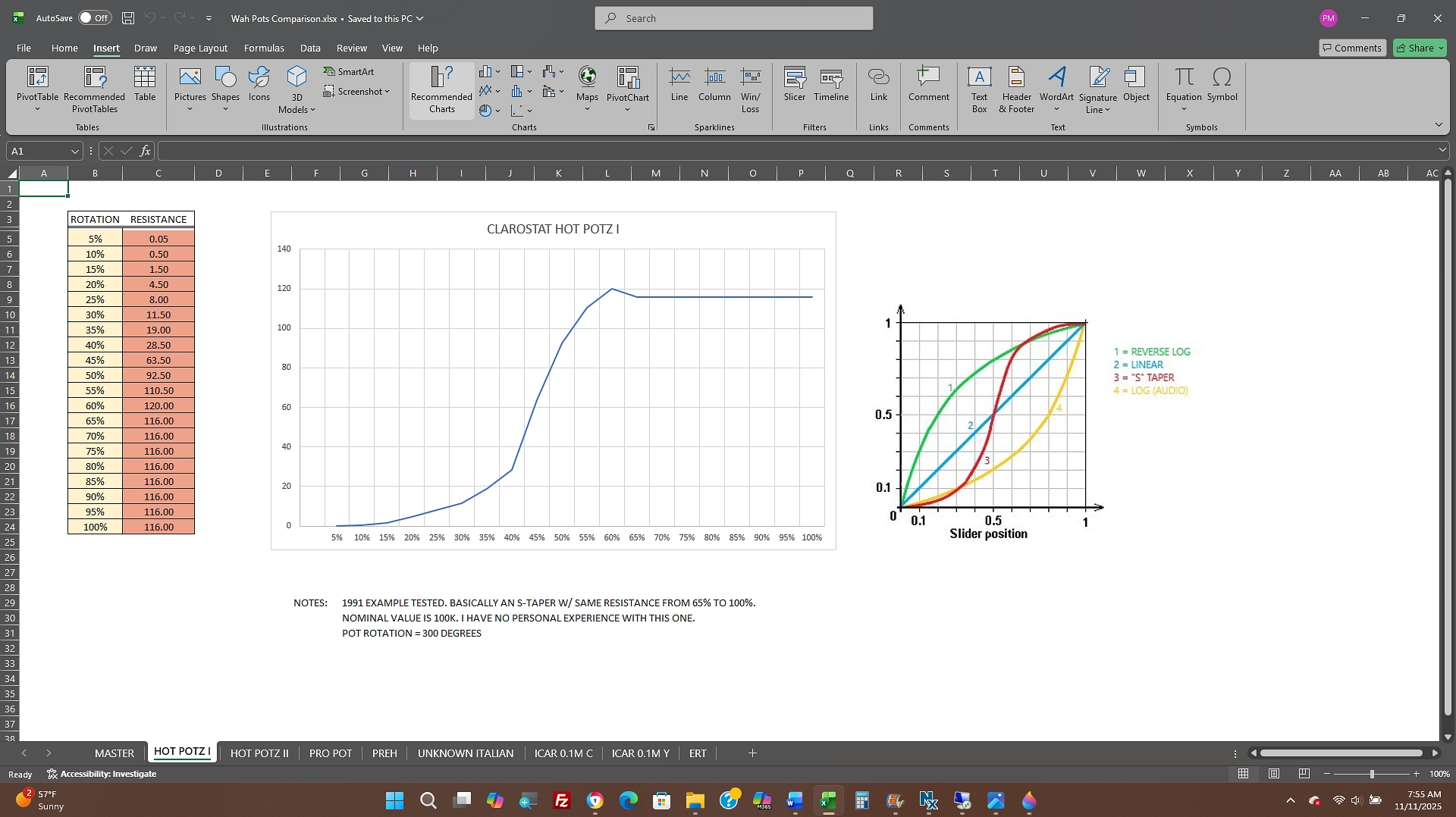
will also behave kind of like a linear pot but will work great for other applications. Linear and audio pots may both be found in a tone control scheme, such as in a tube amp for example. The S-taper is a different kind of beast. Wired up as a volume pot and looking at the output with an oscilloscope, the output of the Hot Potz I pot (S-taper) is striking. For about the first 40% of the pot rotation the ampltitude is very small.
Between 40% and 50% the amplitude doubles. Between 50% & 55% the output doubles again. Between 55% & 60% the output doubles once more. Between 60% & 65% the output doubles
yet again. Beyond that the output remains the same. Most of the "action" is between 50% and 65%, where "the sweet spot" would be. So we can see that most of the change in
the output occurs in only 15% or so of the pot's rotation. This is exactly what we would want in a wah pedal with a short travel of the treadle. This is also why a linear pot
in a Vox type wah pedal will never work that well in terms of expressiveness, although it can be fine in some other types of wah pedals.
Some wah pedals such as the Colorsound Wah Wah or Ace Tone Wah Master use a treadle with more travel and a linkage system which counterintuitively does not necessarily allow for more rotation. The pot in my Colorsound Wah Wah only rotates about 100 degrees. In my Colorsound Wah Wah, what appears to have been the OEM pot (unmarked Bournes) was verifed to be a 100K audio taper.
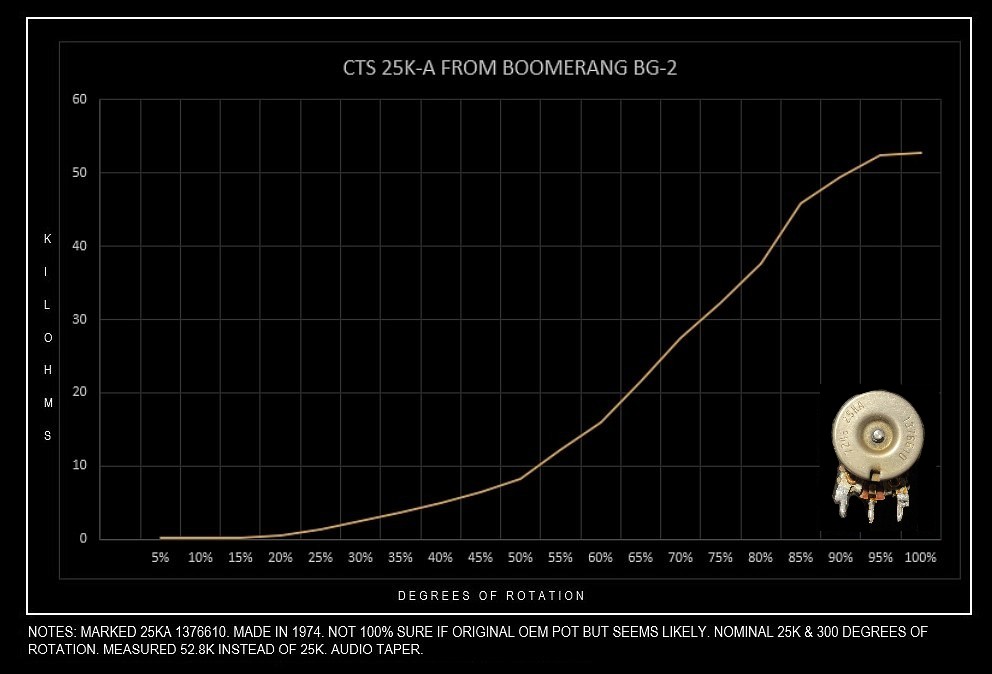
In the first Maestro Boomerang BG-2 wah/volume pedal I acquired what appears to be the OEM pot, a CTS 25KA pot made in 1974, was verified to indeed be an audio taper. This to me worked fine in that circuit.
Below are the curves of ten different nominal 100K wah wah pedal pots that I measured, the 200K "Pro Pot", and also the unknown brand 100K Italian made dual pot I used as a replacement in my Farfisa Wha Wha / Volume pedal. I also included the 25K pot that was in the first Maestro Boomerang BG-2 that I acquired nearly 20 years ago now. What surprised me is just how similar some of them are when it comes to the "sweet spot" region. See also the notes at the bottom of images for additional information/commentary.
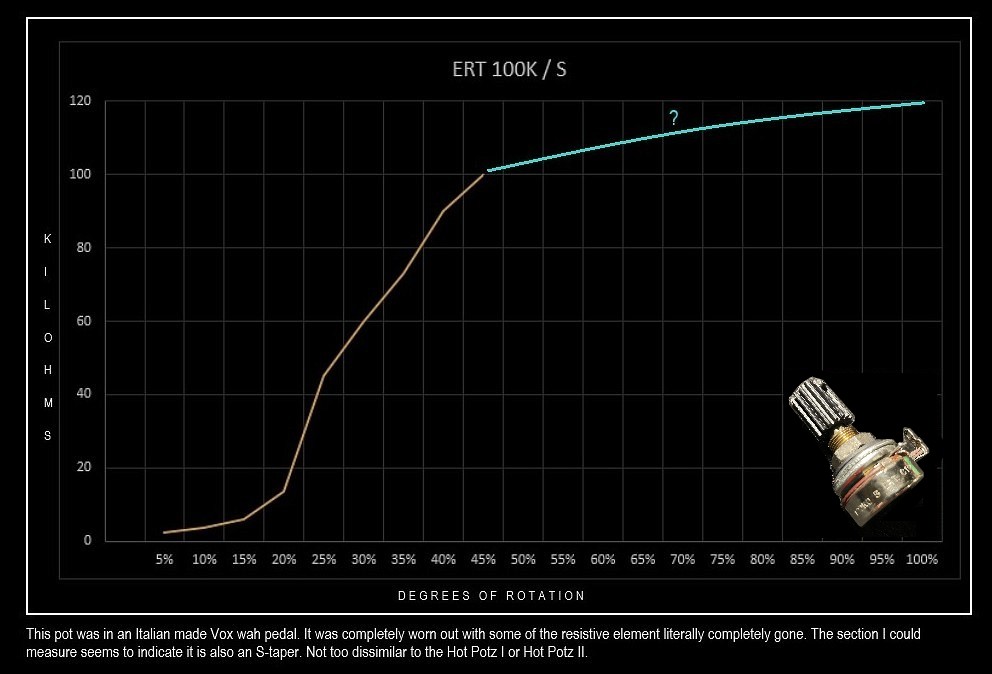
First I measured the ERT pot that came out of my Italian Vox wah pedal with red Fasel inductor. There was an area in the middle of the resistive element that was completely worn away, so I could not measure the total value or get measurements for the full range BUT I think there was enough there to determine that it may be an S-taper, although it looks more like a
reverse log in the overlay towards the bottom of this page.
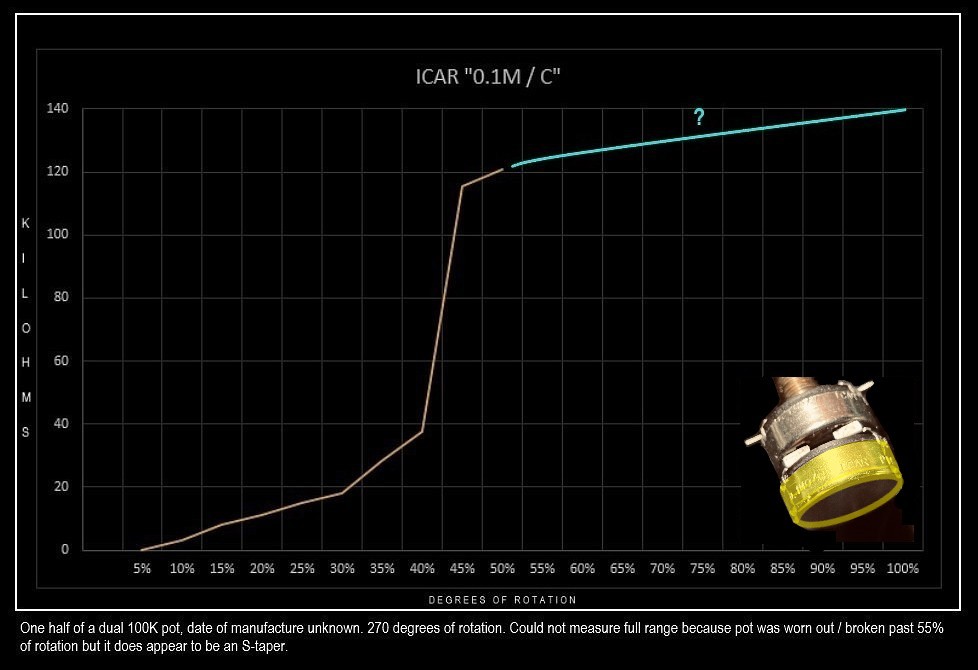
Next we have the ICAR "0.1M / C" pot mentioned at the top of this page. There's a break or something in the resistive element (that I can't see) because there is no continuity between lugs 1 & 3, but there was enough there to get a very good idea of the curve on it. It appears to most definitely be an S-taper. I have read that the "C" designation on European manufactured pots of this time period indicated a logarithmic taper. Could it be that this pot is simply a poorly made log taper, and that quirk turned out to be great for use in a wah pedal? Likely these pots were cheap and available, and not necessarily very good quality. The fact that some examples have drifted in value to 200K or more supports that supposition.
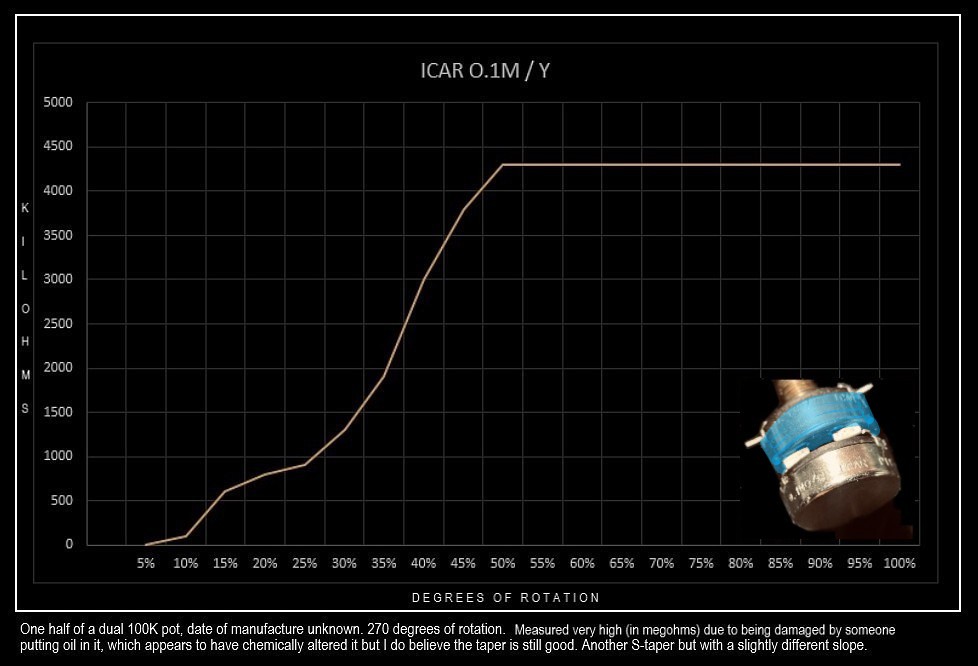
Next there is the "0.1M / Y pot mentioned at the top of this page. It is also an S-taper but with a steeper slope, which in the Farfisa Wha Wha / Volume pedal makes sense. I believe the resistive element in this pot was chemically altered by someone drenching it in oil and it being there for quite some time. So even though this pot measured 4.3 megohms instead of the nominal 100K, I believe the taper is still representative of what the taper was before someone oiled it. Don't do that. You will ruin your pot! In any case, the more linear-ish slope here works better for the volume function of the Farfisa Wha Wha / Volume pedal. That must explain the two different tapers in the same dual 100K pot. Perhaps the "Y" indicates a custom taper? It could also be that it was something like 1 megohm and they didn't bother using a casing with the proper stampings on it. Your guess is as good as mine.
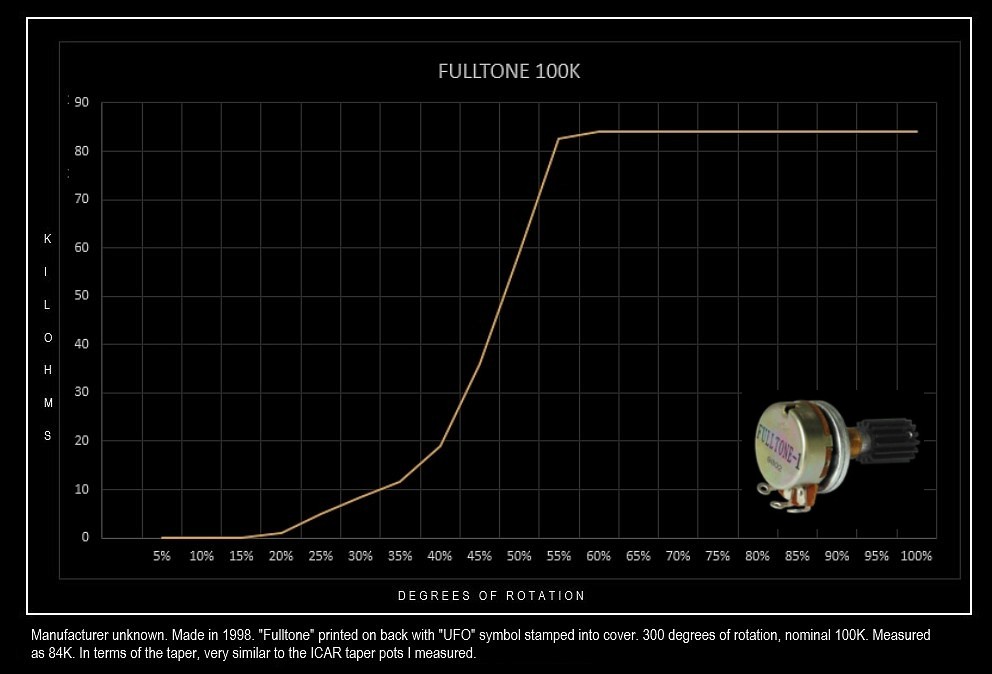
This is a Fulltone-1 pot from 1998. I don't remember exactly how I ended up with this one but it's pretty similar to the ICAR "0.1M / C" pot that I measured. My only comment about this one is that in terms of the carbon track (?) inside it does not seem to be very durable, but I have not dismantled it to see exactly how it's constructed. The 1999 version of the Fulltone website claimed that this pot was made to "the exact specs of the Icar found in the famous '60's Vox wah wahs" and that it would last 34 times longer than the original ICAR pot, with a 500,000 cycle lifespan. Looking at the construction of this pot, I question that claim. It could possibly be a conductive plastic type, in which case it would last a while.
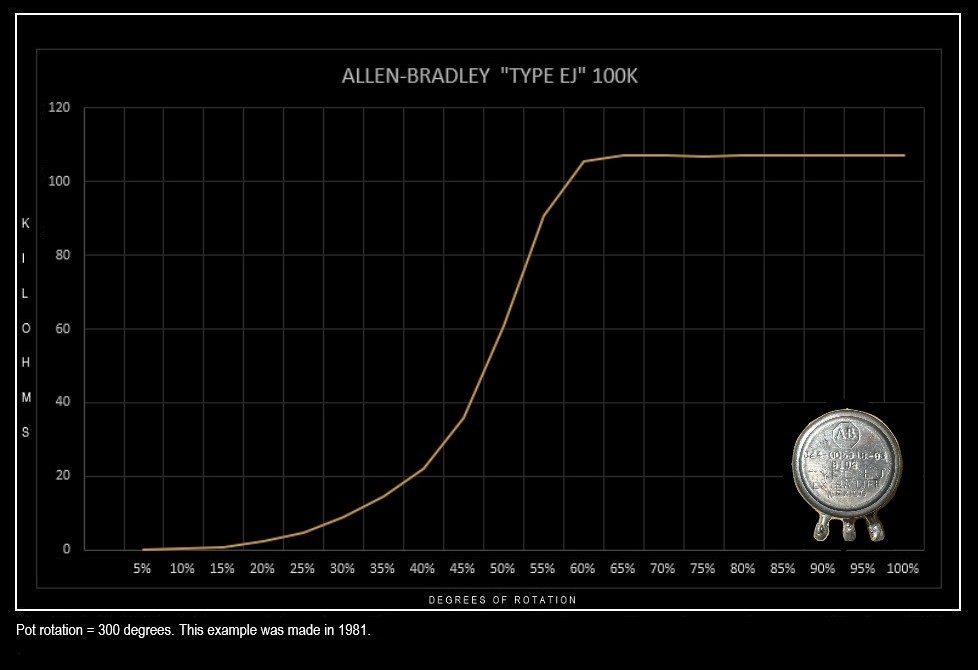
This is the Allen-Bradley "Type EJ", which is similar to the "RV4" military type pot found in Shin Ei wah pedals and "vintage" Ernie Ball volume pedals. This is a heavy duty 2-watt mil-spec type pot. A quick search suggests that it is allegedly good for at least 100,000 cycles. I believe these were used in 80s Cry Babys. It's another S-taper and is very similar to the Clarostat Hot Potz I below, but has a smoother taper. Very much like an audio taper with the last two-thirds being dead flat.
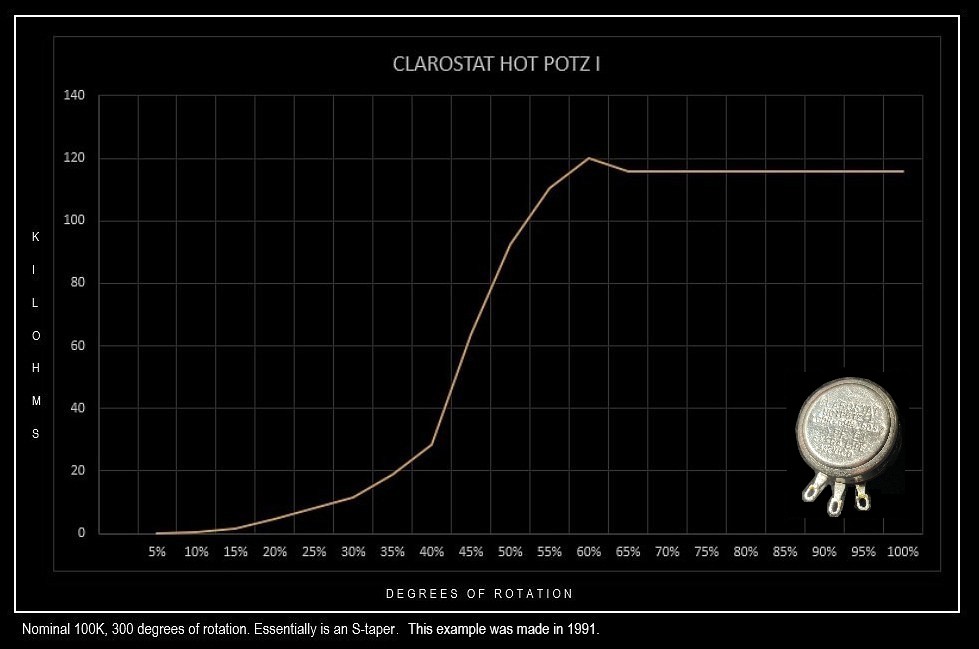
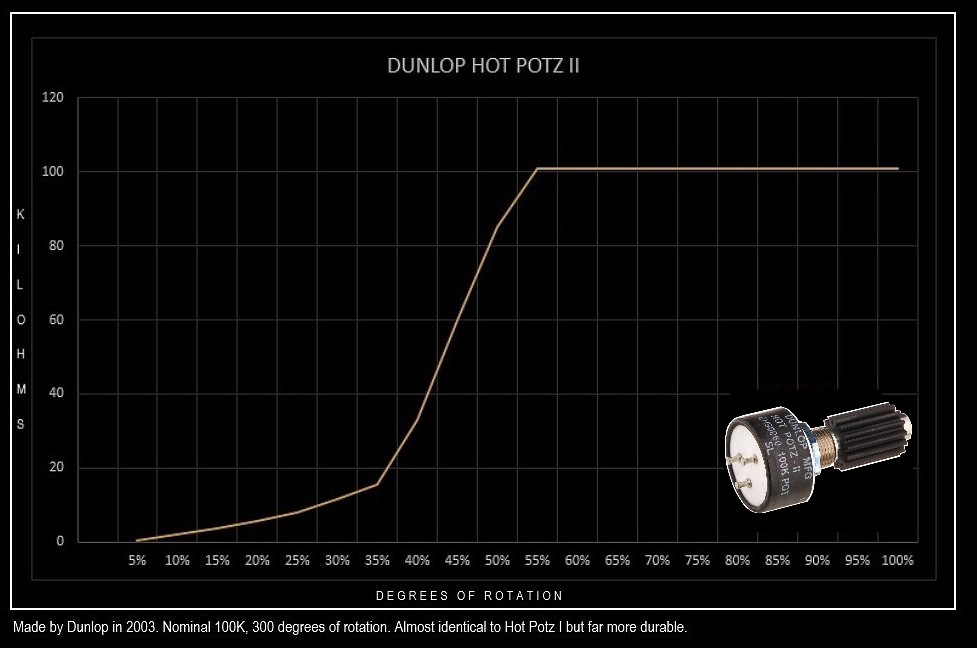
This is the Clarostat/Dunlop "Hot Potz 1". It is a heavy duty "Type EJ" 2-watt mil-spec style pot, which is similar to an "RV4" type. Per the Clarostat catalog (page 5) this is an extra long life type pot which utilizes conductive plastic. I don't know if that was the case at the time when this example was manufactured. I imagine so but I can't say with 100% certainty. In any case, per the internet, these should last for at least 100,000 cycles. We can see that it is clearly an S-taper, with a steep slope and then it goes dead flat from 65% to 100%. Notice how similar it is to the ICAR taper.
This is the Dunlop "Hot Potz II", original version (1995-2017/2018). Note that it's very similar to the "Hot Potz 1" but a little bit different in the 35% to 45% region. It is also very similar to the ICAR pot taper. Notice that it's flat from 55% to 100% - even more than the Hot Potz 1. The Fulltone pot's curve is very similar. The Hot Potz II design was changed around 2018, to a little smaller boxy looking thing.
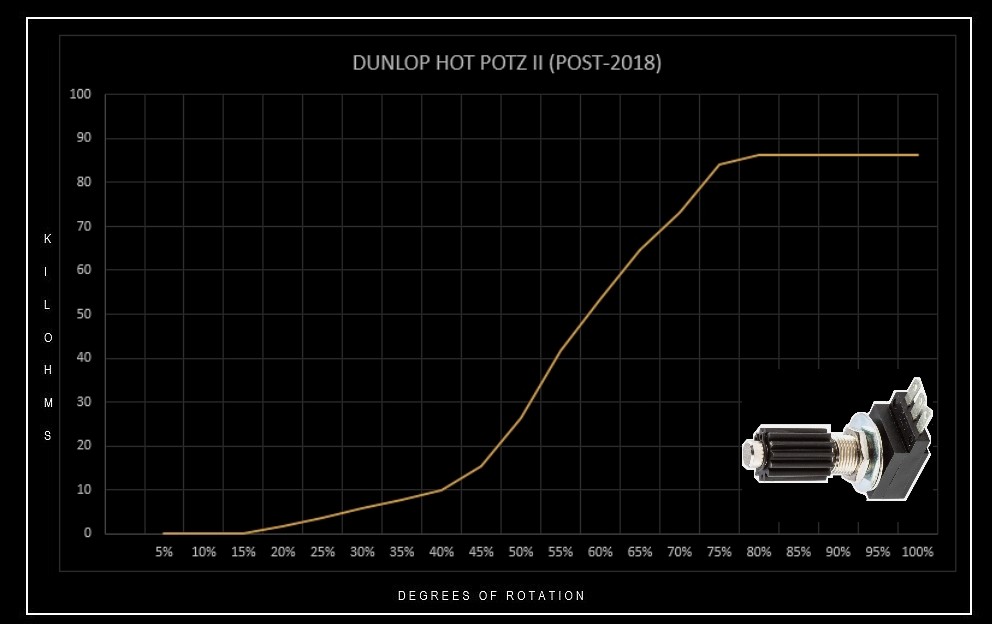
This is the Dunlop "Hot Potz II", current version (post-2018). I mainly picked up this pot just to verify Joe Gagan's claim they changed the taper on this pot. It would appear that they did indeed change the taper. It's a little more flattened, with not as steep of a taper or as much of a kink where it rapidly shoots up. That's interesting. I was not aware of this until recently but good to know. The one I received was not as close in tolerance as the original version. Total resistance was only 86.4K vs. 101.3K, respectively. Not sure if that is intentional or if manufacturing standards have went down in recent years (loose tolerances). The curve is now kind of in between a 100K ICAR taper and a 200K ICAR taper, which may be a good compromise for guitarists these days.
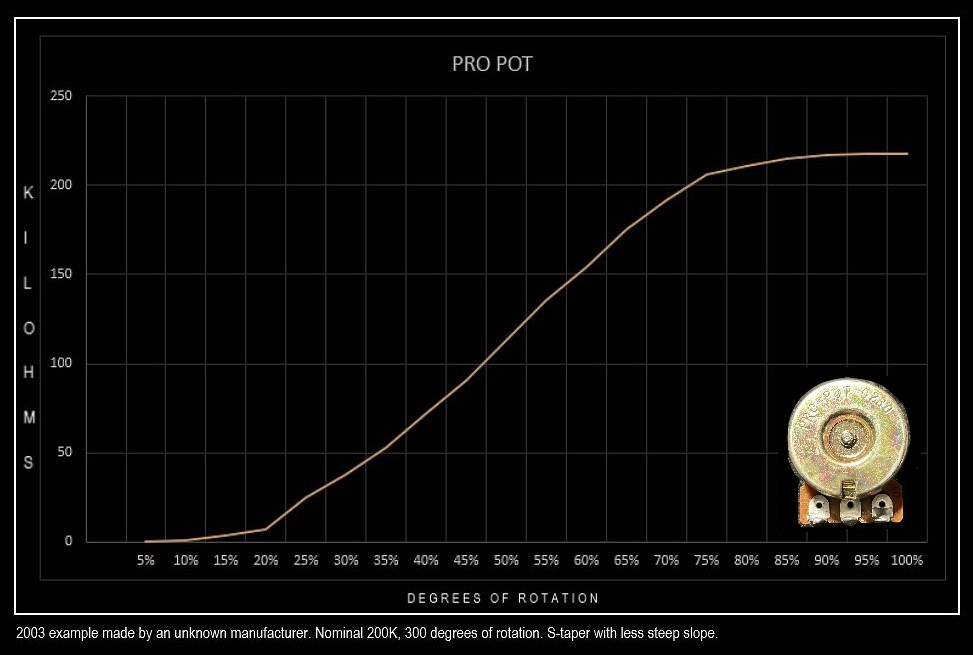
This is the Blackop "Pro Pot" which around 20 years ago seemed to be quite popular. I bought this to replace the scratchy OEM pot in my Italian made Vox wah pedal that I purchased around 2003. As I recall it was supposed to be modeled on a 200K ICAR pot. I remember that I didn't care for it, and that it was also scratchy! Ugh. I replaced that with the Hot Potz II and never looked back. Notice that is also an S-taper, but it's long and drawn out.
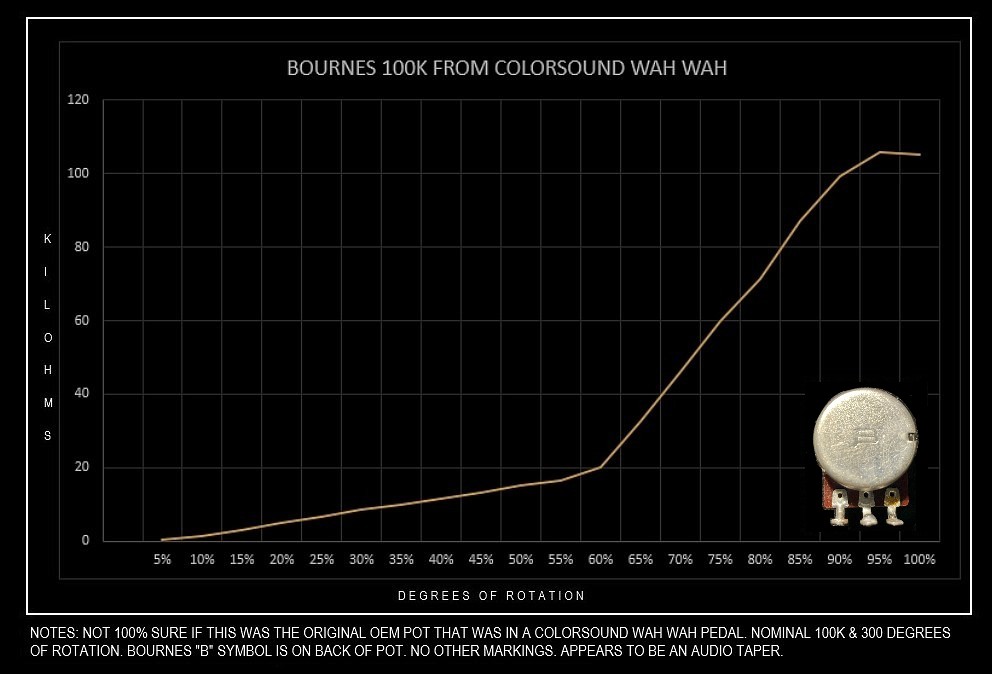
I measured the pot that was originally in the second Colorsound Wah Wah pedal that I acquired about a year ago. It seems to be the OEM pot. Even if it's not, it's representative of the typical audio/log pot taper. In any case it worked well. Note that the curve is more like two linear tapers of different slopes. This seems to be pretty typical of pots that are labeled as audio/log. I remember Joe Gagan once told me (18-ish years ago) that the linkage in the Colorsound was designed to get a log curve out of a linear taper. I don't know if that's true but it does seem to take an audio pot and make it more like an S-taper. Because of the linkage system it's kind of really its own thing. With the Colorsound Wah Wah it's kinda difficult to compare apples to apples, as the saying goes. Whatever the design intent was, the treadle only rotates the pot about 100 degrees, which is interesting because it has quite a range in spite of that.
This is the CTS 25KA pot that was originally in the first Maestro Boomerang BG-2 that I acquired. It's an audio taper. Note that this one has a smoother curve and is more like a true logarithmic taper. This worked good but as preventative maintanence I replaced it with a more durable pot before it wore out and went scratchy again. As a rule, I won't dismantle a pot more than once to clean it / repair it. That's really only a short term solution. For the record, according to Joe Gagan, the Boomerang originally used a special reverse log taper. Also the orignal Centralab pots were problematic and not conistent in their quality. This was per Richad Mintz. I've known Joe for a long time and I have also had some conversations with Richard Mintz myself, designer of the Boomerang BG-2, but that was never a subject that came up for me. It could well be the pot I have replaced an underperforming OEM Centralab pot before it left the factory, or it came back under warranty (?) from a dissatisfied customer to be addressed. I don't think log vs. reverse log matters much as long as the tapers have a similar slope and can be adjusted to use the range available without messing up the fuctionality of the pedal (such as not interfering with switching effect on/off).
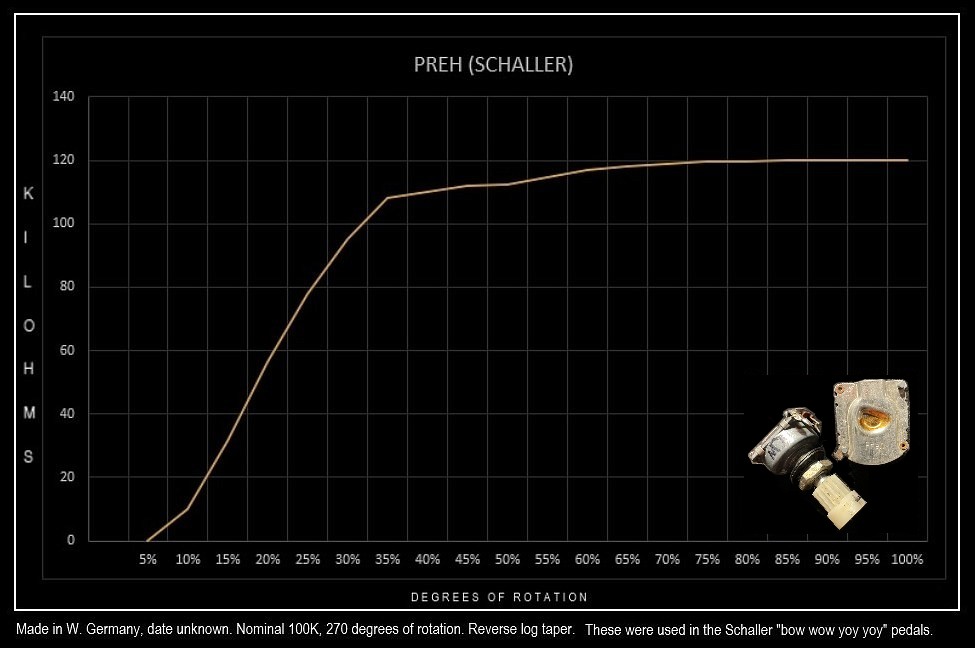
This is the West German made ESA / "Preh" branded pot that can be found in some of the Schaller wah pedals. Someone gave me half a dozen of them years ago and claimed they were reverse log. My measurements confirm that they are indeed reverse log.
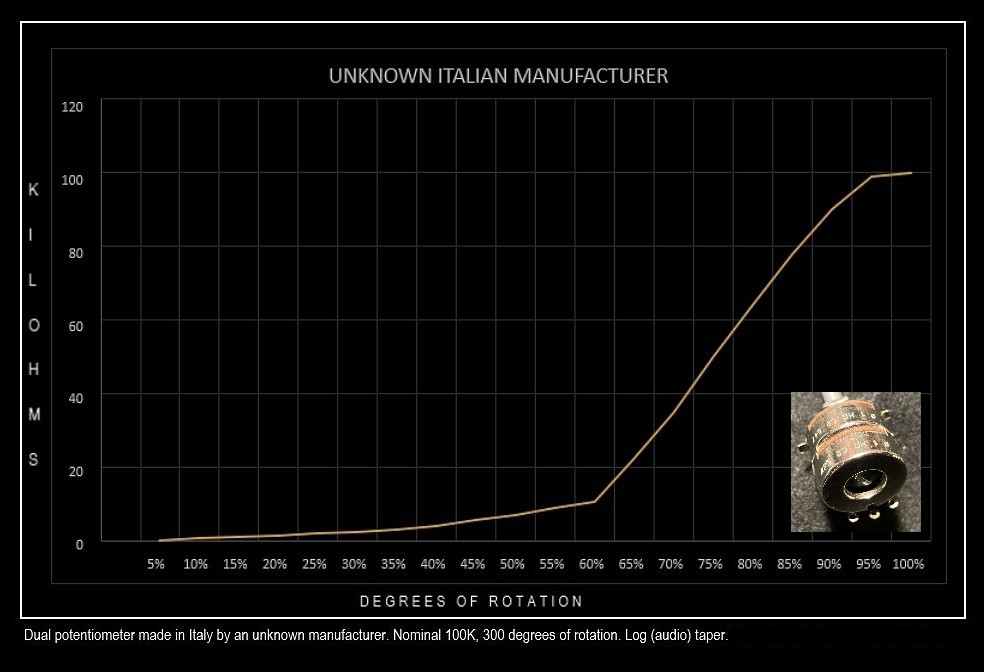
We have now arrived at that unkwown brand Italian made dual 100K audio taper pot I mentioned at the beginning of this page. It works pretty well for the "wha wha" function in my Farfisa Wha Wha / Volume pedal. The curve is steep enough to be suitable for use with a wah wah pedal. Notice how in the first 60% not much is happening.
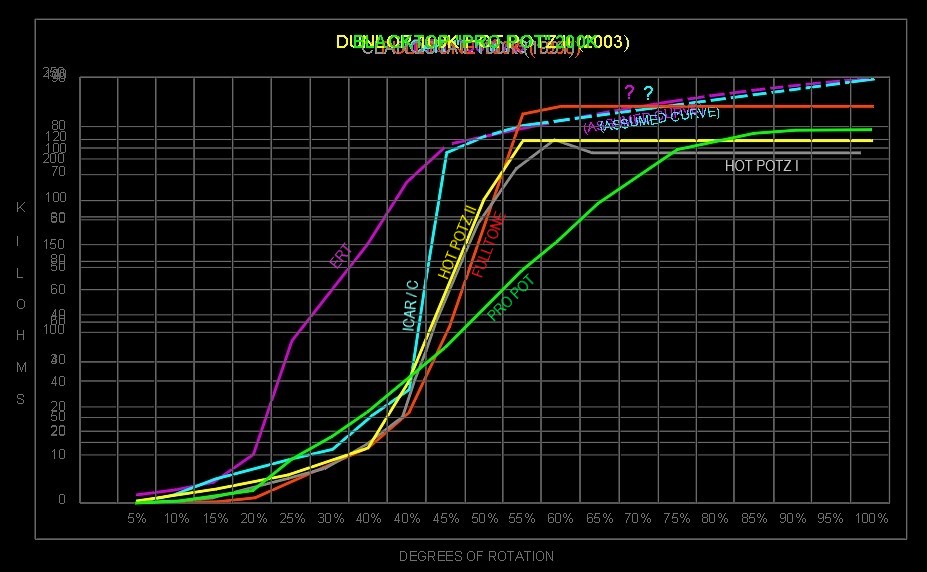
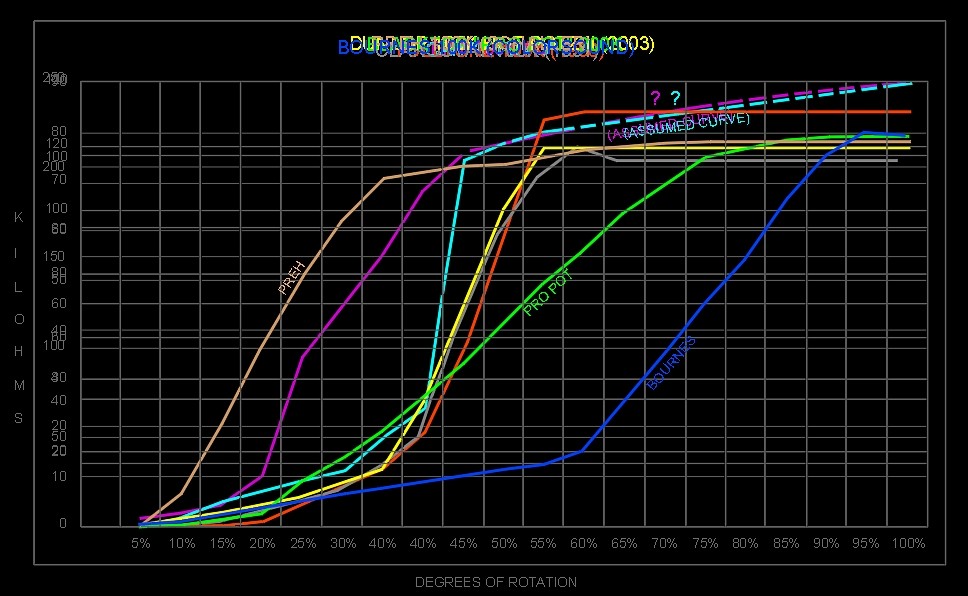
Finally, we have six of these curves superimposed. Most of these are nominal 100K potentiometers, except for the 200K "Pro Pot". Note just how similar three of them are! Colors are as follows:
Magenta = ERT. Cyan = ICAR / C. Red = Fulltone. Grey = Hot Potz I. Yellow = Orig. Hot Potz II. Green = Pro Pot.
This confirms why my ears don't really hear any difference between many of these. The only objective here is to show the rate of change in resistance with every 5 percent of rotation. Nota bene, the ERT taper might be off as I only had one example to test. If the ERT curve is accurate, it almost looks like a reverse log taper compared to
the others. The Pro Pot looks very linear compared to the rest, but it's really a kind of flattened S-taper.
Of all these pots, only the ICAR / C has 270 degrees of rotation. The rest are 300 degrees. Note that the ICAR / C taper is steeper due to 30 degrees less rotation
available. According to these findings, technically speaking, a pot that claims to replicate the ICAR taper in 300 degrees will miss the mark if it fails to take into account that the ICAR pot was limited to only 270 degrees of rotation. Therefore, it appears that the Fulltone curve for example should be a little steeper. In any case, whether or not anyone can actually hear a difference between a 270 degree pot and a 300 degree
pot with approximately the same taper is another matter. It's hard to rule out pyschoacoustics, where people hear what they want to believe. As a mechanical engineer type, I am probably different than most because
I tend towards skepticism and seek proof of claims made instead of just taking people's word for something. That's why I go thru these sorts of exercises (in addition to just being
curious).
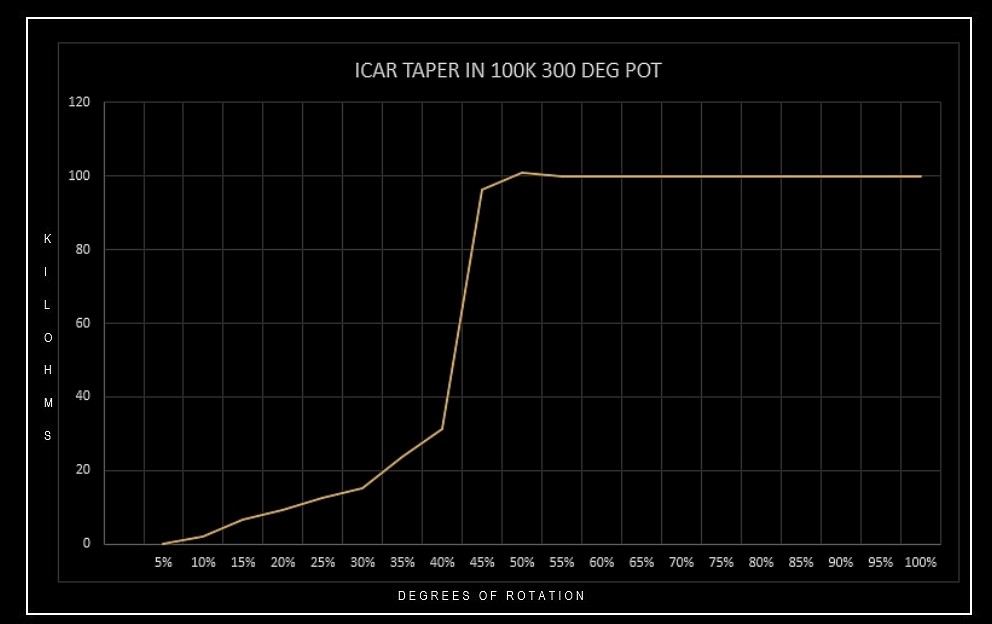
Anyway, compensating for 300 degrees of pot rotation, I believe the image below is how the curve should look if it was truly replicating the ICAR taper. In reality this may be
splitting hairs, and I am not sure if anyone could really detect the difference. Likely it's very subtle. It's just something I thought I'd point out.
If we add the reverse log ESA / Preh pot (brown curve) and the audio/log Bournes pot (blue curve) to the overlaid curves, we can see how different the response of the reverse log and log tapers are from the others, and yet all of these work well in the right context. It really is to a large extent dependent on the circuit topology and enclosure design - how much travel the treadle has. Comparing the ERT to the Preh, I am wondering if the ERT pot is actually a reverse log type. Would need to test a few others to really know. Unfortunately, obtaining some of these pots is not an easy task these days - it was a lot easier to do when I entered the DIY world in 2001. If you have some junk wah pots that you'd like to send me, please contact me via the email on the home page!
Speaking of enclosure design, another factor to consider is the treadle's degrees of movement around its pivot point and the gear ratio, which will affect how much the shaft on
the pot can be rotated throughout the range of the treadle's movement. Not all wah pedals that utilize the familiar
rack & pinion arrangement use a system that has exactly the same specifications as the Vox and/or Cry Baby. Some of them seem to have an extreme amount of treadle movement, such as the Ace Tone "Wah Master", and others not much at all. And in some of these with little travel, there can be a large range with relatively little movement of the treadle (or in some cases, rotation of the pot). So I decided to quantify these parameters in some of the various wah pedals I possess, and tabulate them into a table for easy comparison.
The degrees of rotation of the potentiometers on the table below are approximate. I did that visually either by putting a mark on the end of the pot shaft, using some other easy reference point or a dial arrangement on the pot itself. Having done a lot of board drafting when I first started in consulting engineering in 1989, I've used protractors and 45 degree, 60 degree or adjustable triangles quite a lot so it's not difficult for me to eyeball it when it's the only alternative. It'll be in the ballpark. On the Cry Baby, Vox and Maestro Boomerang I was able to use a little dial that fit on the end of the gear to determine degrees of rotation (shown in the pictures below). It's also hard to nail down the exact number of degrees that the treadles rotate around
their pivot points, but I think I'm pretty close. This will also vary somewhat depending on how much force it takes to switch the effect on & off, as that may affect the range of
travel by something like 1 degree. All of these pedals are in their stock configuration, with all of the rubber bumpers and/or felt pads still in place. I know people will sometimes remove these to increase the range, but that does not apply here.
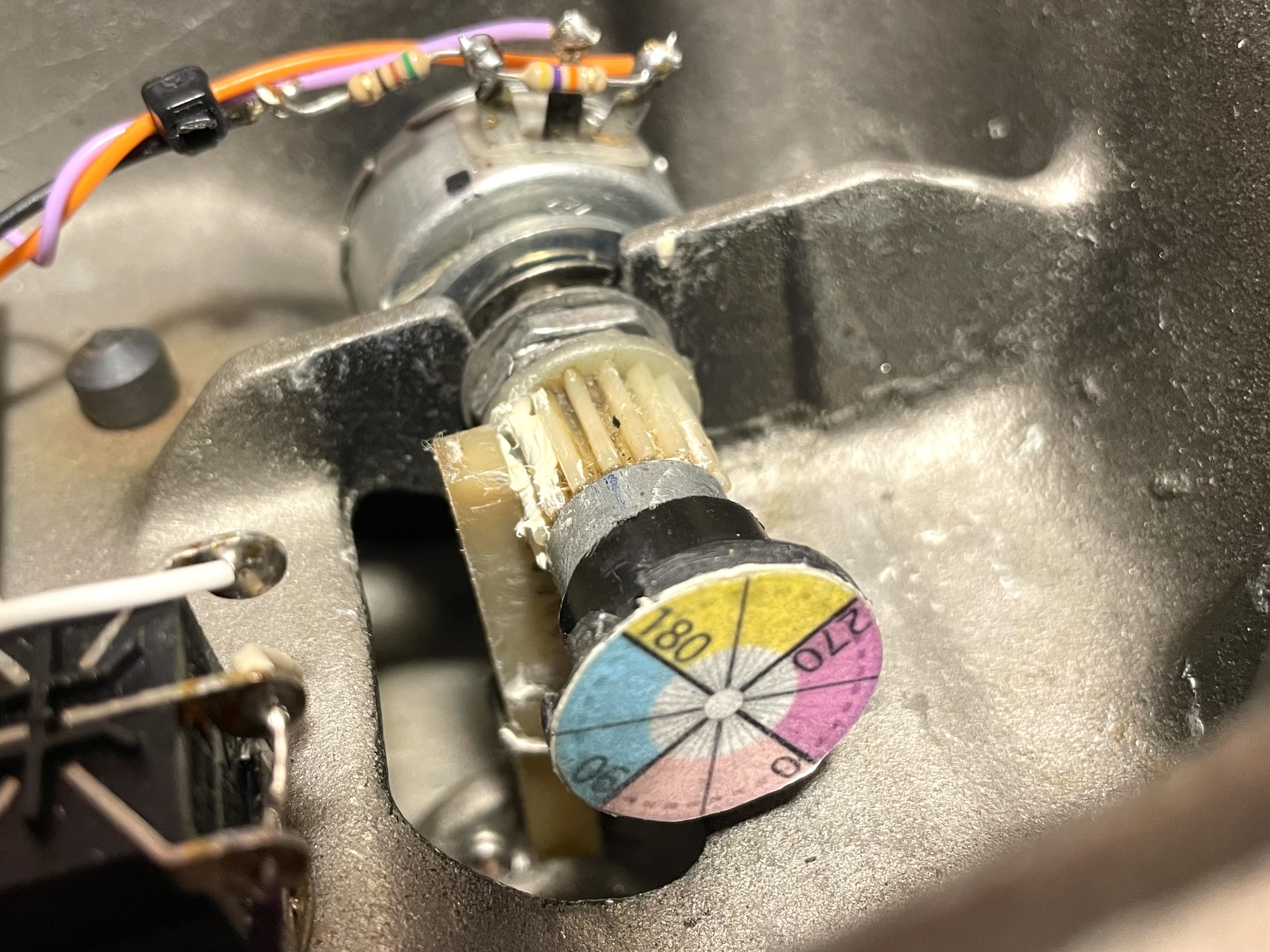
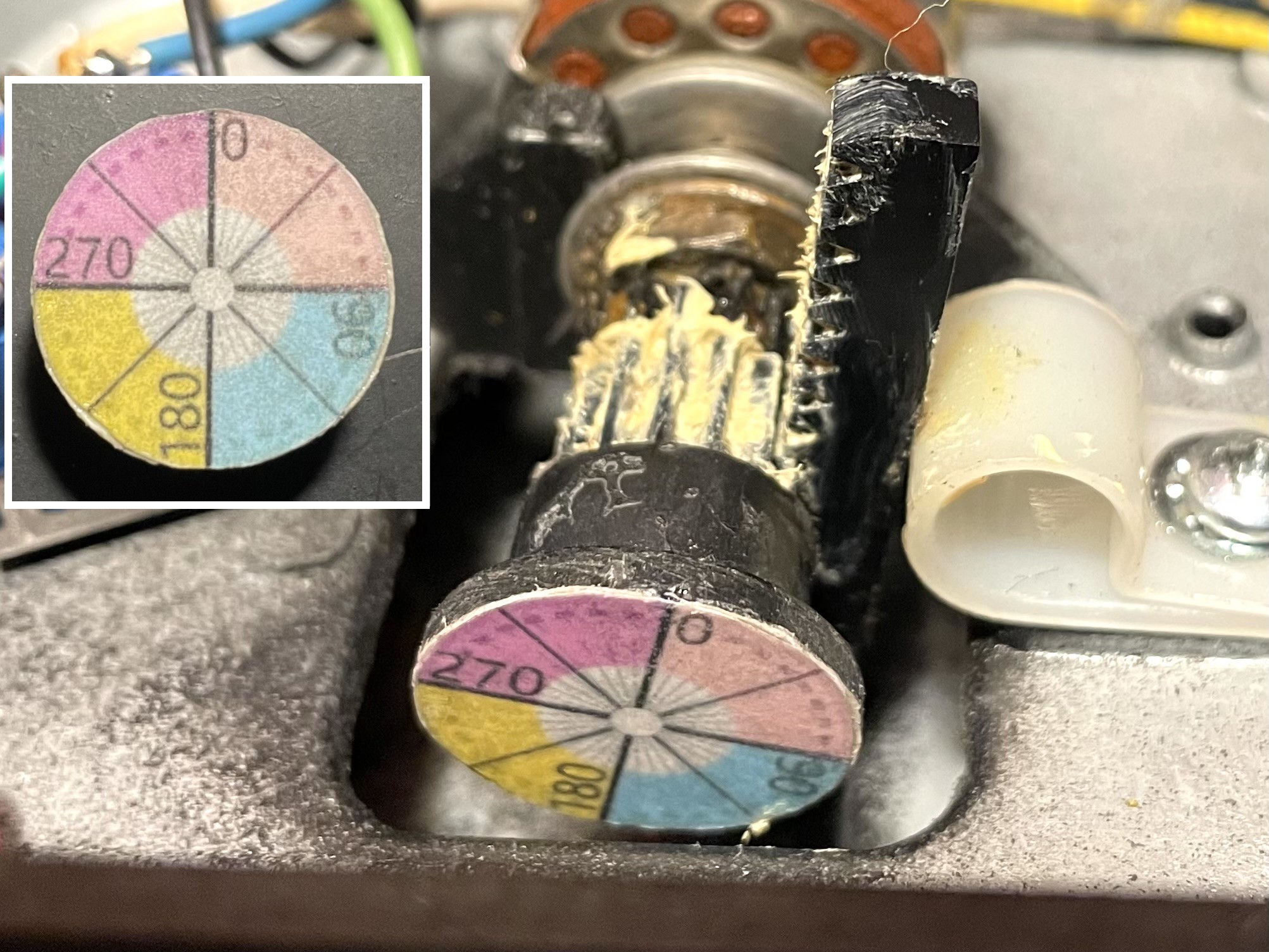
From these various measurements I derived the table below. The gear rack ratio was derived using this formula: R = T / (2 * π * r). The variables are R which is the gear rack ratio, T which is the number of teeth on the pinion gear and r which is the radius of the pinion gear.
|
WAH PEDAL TREADLE & PINION GEAR COMPARISON
|
| Wah Pedal Brand & Model | Treadle Degrees Of Travel | Distance Between Pivot Points | Pinion Gear Number Of Teeth | Pinion Gear Diameter | Gear Rack Ratio | Pot Degrees Of Rotation | % Of Total Rotation (300 deg pot) |
| Vox, Italian, Red Fasel (ca. 1970) | ≈ 8-9 | 4.625" | 14 | 0.50" | 7.69 | ≈ 180-190 | 60-63% |
| Dunlop "Cry Baby" (mid-2000s) | ≈ 12-13 | 4.625" | 14 | 0.50" | 7.69 | ≈ 235-240 | 78-80% |
| Maestro "Boomerang" BG-2 | ≈ 10 | 5.625" | 16 | 0.55" | 8.79 | ≈ 225 | 75% |
| 1st pattern Schaller "bow wow" | ≈ 10 | 4.875" | 15 | 0.47" | 8.77 | ≈ 225 | 75% |
| Farfisa "Wha Wha / Volume" | ≈ 8-9 | 5.75" | 30? | 0.50" | 16.48 | ≈ 180-190 | 60-63% |
| Colorsound "Wah Wah" | ≈ 15 | -- | -- | -- | -- | ≈ 100 | 37% |
| Ace Tone "Wah Master" | ≈ 22 | -- | -- | -- | -- | ≈ 90-100 | 33-37% |
From this table we can see that where the pot taper matters the most is in the ubiquitous Vox wah pedal as it has the smallest amount of travel. This also conincides with the
short travel of the Farfisa Wha Wha / Volume, which interestingly came equipped with a dual 100K ICAR pot. Number of gear teeth on the Farfisa was estimated as I did not want to take that
pedal apart, due to it being a real pain in rear to work on. Might only be something like 28. They are small teeth and there's a lot of them compared to the Vox with 14 teeth.
In the case of the Vox wah pedal with a 270 degree ICAR pot, the treadle's full range of movement would equate to about 67-68% of the pot's total rotational movement. Also interesting
is how the inductor-based version Colorsound Wah Wah has such a huge range even though the pot only rotates little more than 1/3 of the possible 300 degrees. I think that's partly because the Colorsound Wah Wah circuit does not have a "Q" resistor in parallel with the inductor. The Ace Tone Wah Master is in a league of its own, being an inductorless type circuit.
I found the results of this testing to be most interesting. The thing that struck me the most was how similar the Hot Potz I and original Hot Potz II pots are to the much quoted
ICAR taper. The ICAR seems to be referred to as the perfect wah pot taper. To me it is kind of silly that people will pay a lot of money for
various pots that claim to replicate the ICAR taper, which will likely wear out and become scratchy relatively quickly. In my opinion, the best replacement pot is the Dunlop Hot Potz II version shown below. It's close enough to these other tapers and it will virtually never wear out. The fact that they are so durable is much more important to me. However, it can be difficult
to use the Hot Potz II in some non-Cry Baby type wah pedals where the form factor is a bit different and the pinion gears on the pots do not have the same size or number of teeth.
In those cases some amount of improvisation is required, or you have to find something close as possible to the original, as was the case with my Farfisa Wha Wha / Volume pedal. Just for fun I calculated how long a Hot Potz II should last with the claimed 1,000,000 cycles. Assuming you're using the wah pedal continuously for an hour and on average cycling it 30 times per minute, it should last about 5,556 hours before it wears out. Now that's equivalent to 2.67 years of 40 hour work weeks.
Speaking of inductors, their purpose in the wah circuit is to make it a resonant circuit. It even says that in Brad Plunkett's patent. Having done my own testing on inductors via a
curve tracer and an oscilloscope, and also by using them in my own DIY circuits, there's not anything magical about them as far as I am concerned. The only differences I observed were what happens around 50-60 Hz, and where the resonant frequency was. All of the ones I analyzed had resonant frequencies above the range of hearing - in the 25-30 kHz range, or even higher than that. Also, for example, I discovered that the 660mH Dunlop inductor and the 500mH red Fasel were virtually indentical in terms of frequency response! And yet people routinely change the "crappy" OEM Dunlop to a red Fasel, believing it's an improvement. I've done it myself. Enter that pesky pyschoacoustics thing again. In reality, anything from 350mH to 1H will work. RG Keen in his "Technology Of Wah Pedals" page does talk a bit about how inductors saturate, and while technically there is something there you can see on test equipment, in my experience you get far more out of changing virtually anything else in the circuit. So, aside from messing with sweep and/or coupling cap values and perhaps transistor gain(s), changing the pot will give you the most bang for the buck. It can really change the character of your wah pedal, because your foot is what controls the expressiveness. And that is where personal preferences comes into play.
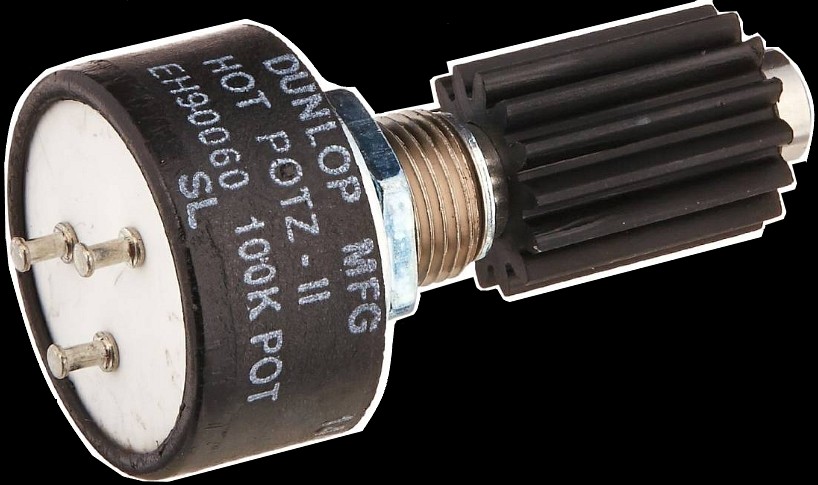
In conclusion, these tests and measurements shed some light on what players are actually fussing about when it comes to this subject. It seems to me that it has to do with the steepness of the taper, how condensed it is and the smoothness of the transition in the area where the resistance rapidly shoots up. With the steep slope of an S-taper it will be a bit more aggressive, and with less movement of the treadle. It will be more "quacky". With an audio taper it's a bit less aggressive with a smoother sounding
range a bit more spread out, but more work to achieve the "whacka whacka" sound. I tend to like the audio taper better. The reverse log pot is hard to pin down. It doesn't sound that different to my ear than an audio taper, but in the Schaller "bow wow yoy yoy" it definitely seems to sound better than an audio taper. The circuit these pots are used in also is a factor. Some circuits are in a league of their own and there is no "one size fits all". In any case, going thru this exercise has been enlightening. It definitely is as personal preference thing just as much as guitar strings, guitar picks, etc. Different strokes for different folks...